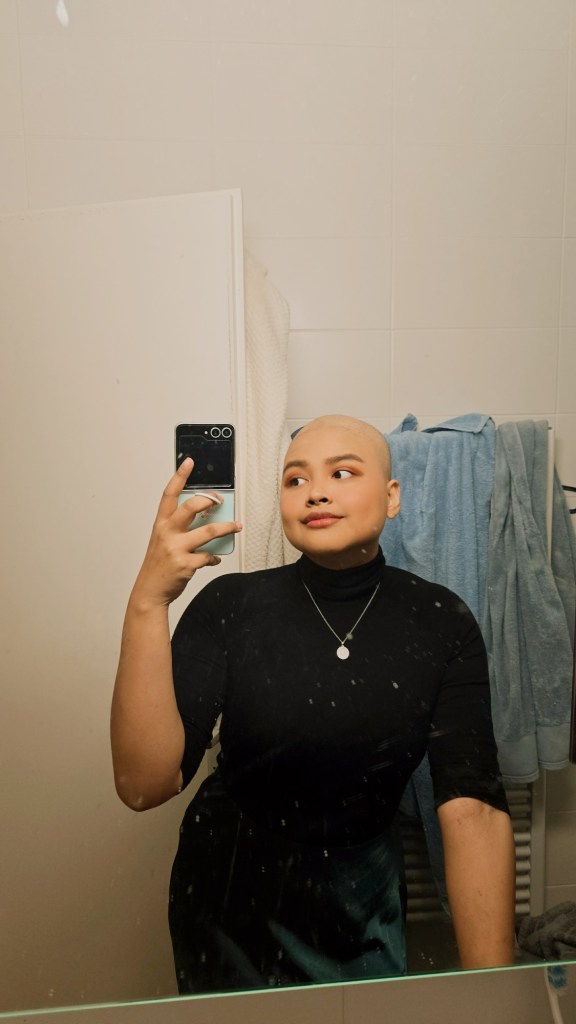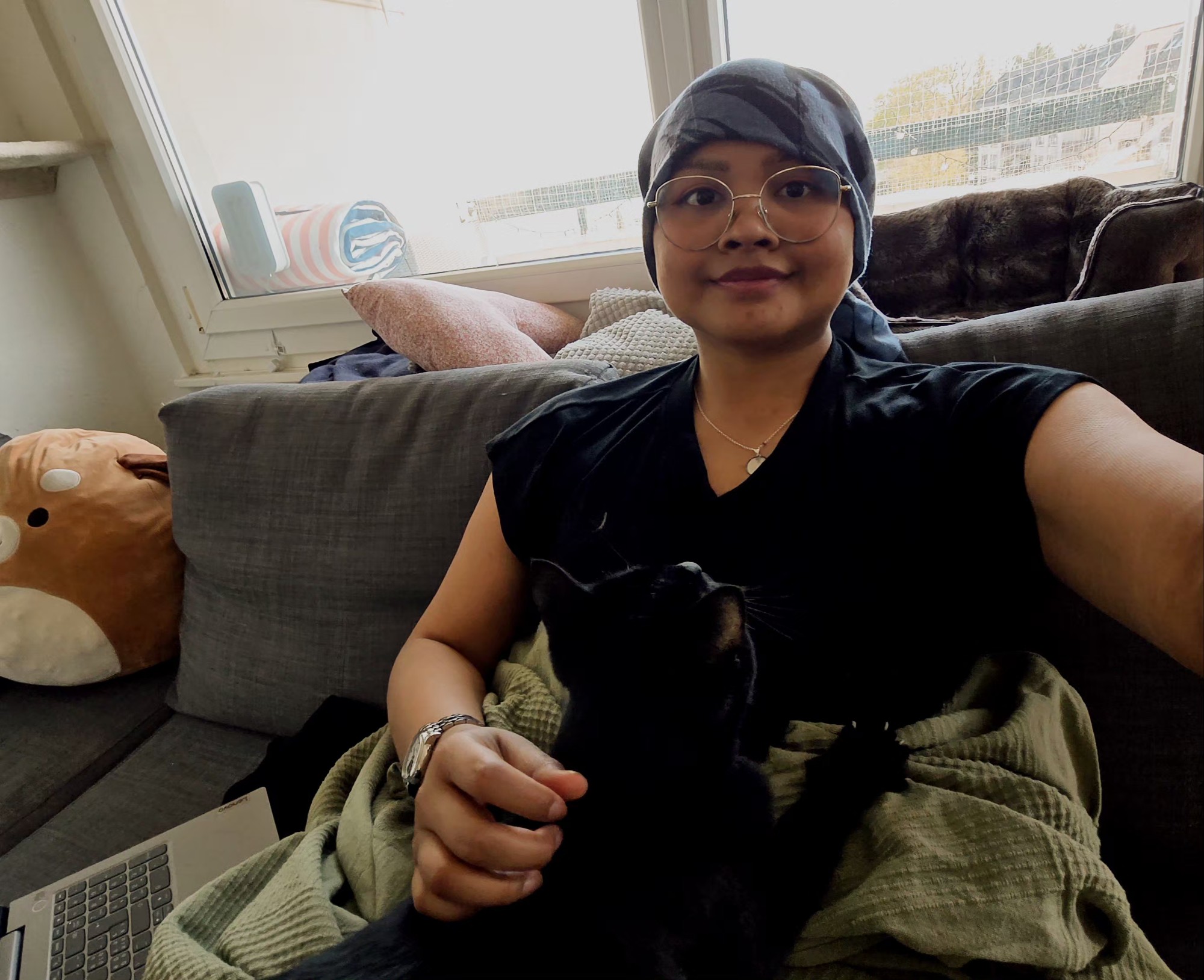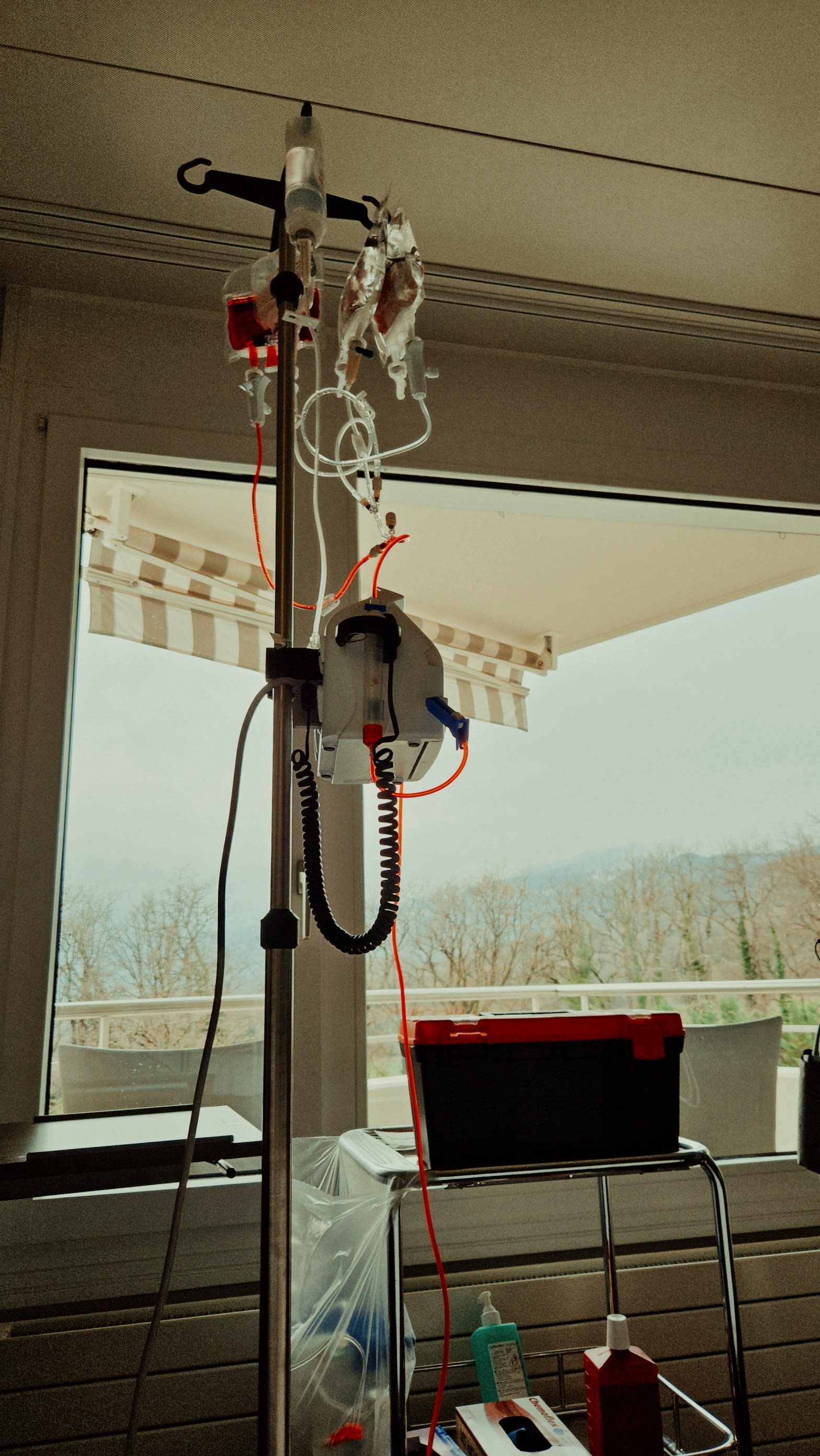
Après le « dernier » traitement

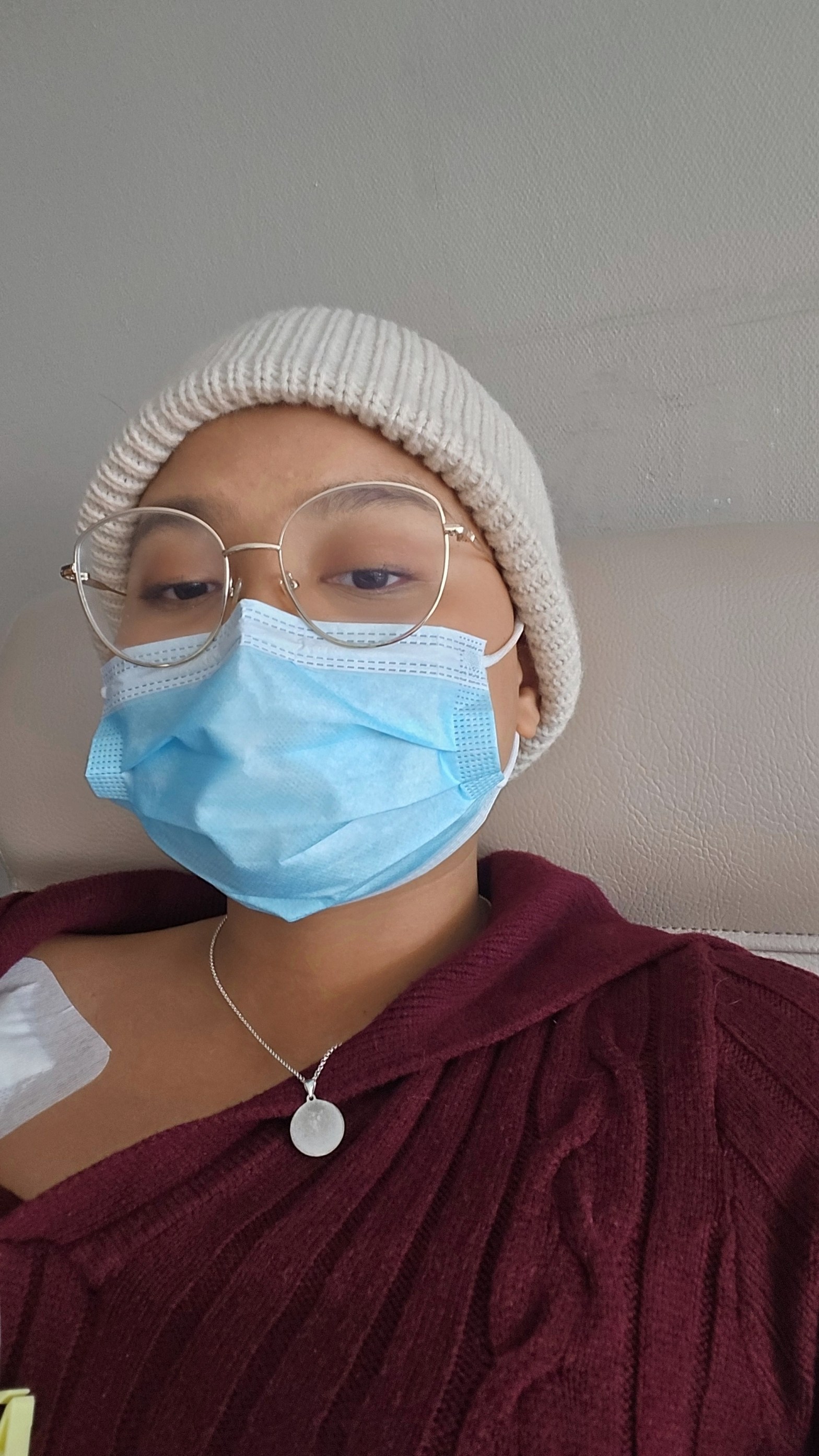
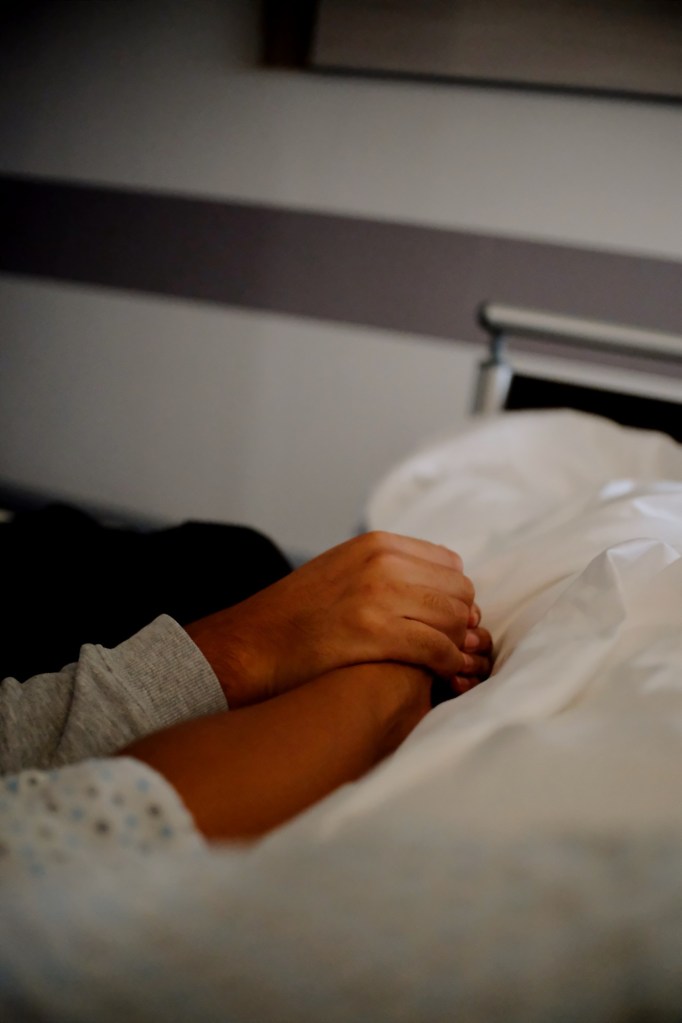
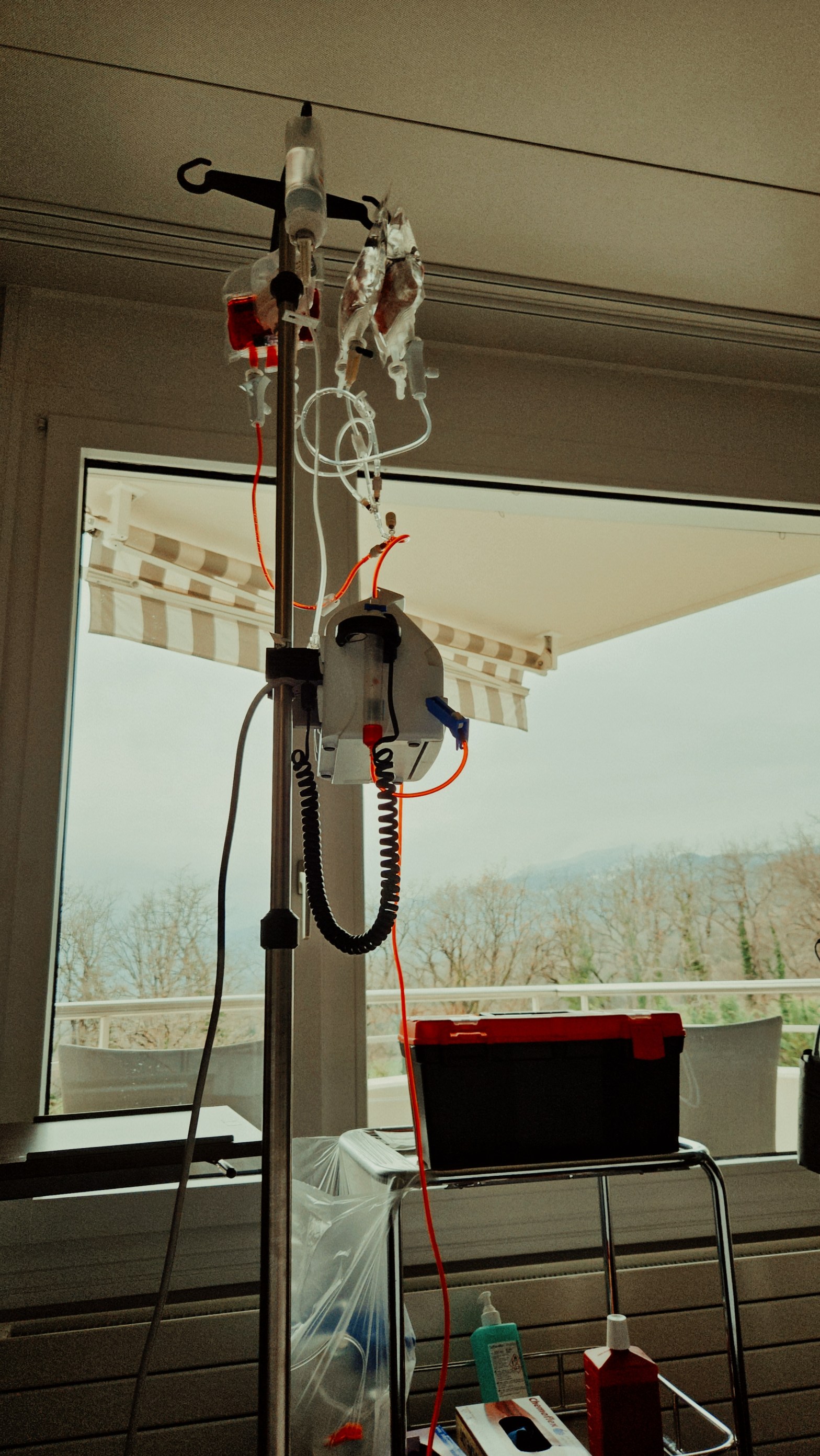
Le 1er avril 2025, j’ai reçu ma dernière chimiothérapie.

La dernière.

Après quatre EC.

Après douze Taxol.

Après des mois à compter les semaines, les prises de sang, les perfusions, les médicaments, les effets secondaires et les jours où mon corps arrivait encore à suivre.

Ce jour-là, un chiffre était enfin arrivé à zéro.

Il n’y aurait pas de treizième Taxol.

Pas de prochaine séance de chimiothérapie à inscrire dans mon calendrier.

Pas de « à la semaine prochaine » en quittant le service.

J’avais terminé la chimiothérapie.

C’était censé être une bonne nouvelle.

Et ça l’était.

Je crois.

Les gens étaient contents pour moi.

On me félicitait.

On me disait que j’avais été courageuse, que j’avais tenu jusqu’au bout, que le plus dur était derrière moi.

J’entendais leurs mots.

J’essayais même parfois de les croire.

Mais à l’intérieur de moi, il n’y avait pas cette explosion de joie que j’aurais imaginée.

Pas de grande victoire.

Pas cette sensation spectaculaire d’avoir gagné quelque chose.

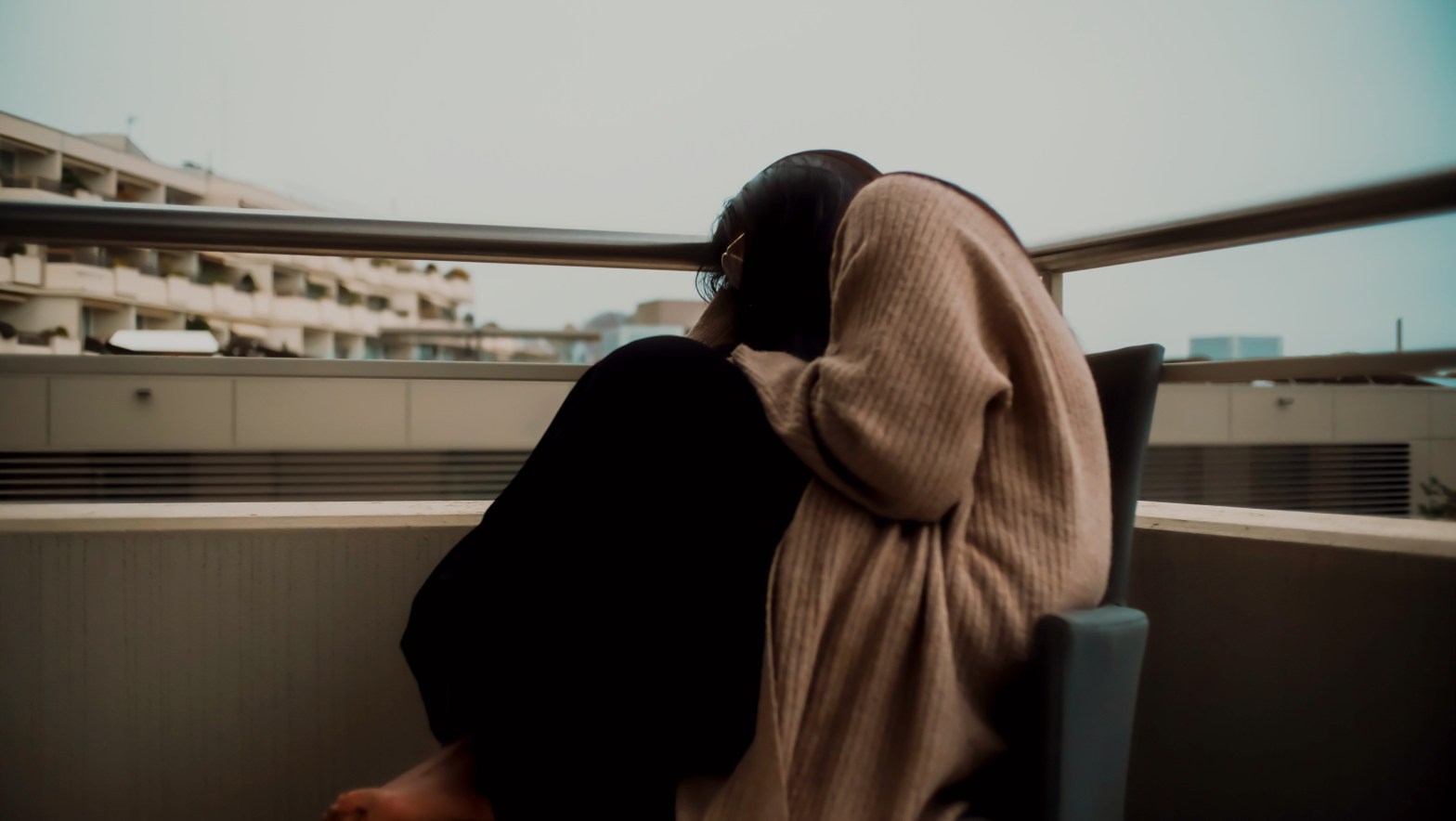
J’étais surtout fatiguée.

Profondément fatiguée.

Et peut-être un peu perdue.

Pendant des mois, ma vie avait été organisée autour des traitements.

Il fallait tenir jusqu’à la prochaine séance.

Faire la prise de sang.

Attendre les résultats.

Recevoir la perfusion.

Rentrer.

Supporter les jours suivants.

Récupérer suffisamment.

Puis recommencer.

Je n’avais pas besoin de savoir où j’allais.

Le calendrier le savait pour moi.

Et soudain, une partie de ce calendrier s’arrêtait.

On pourrait croire que lorsqu’un traitement se termine, on récupère immédiatement une partie de sa vie.

Mais mon corps, lui, n’avait pas reçu le mémo.

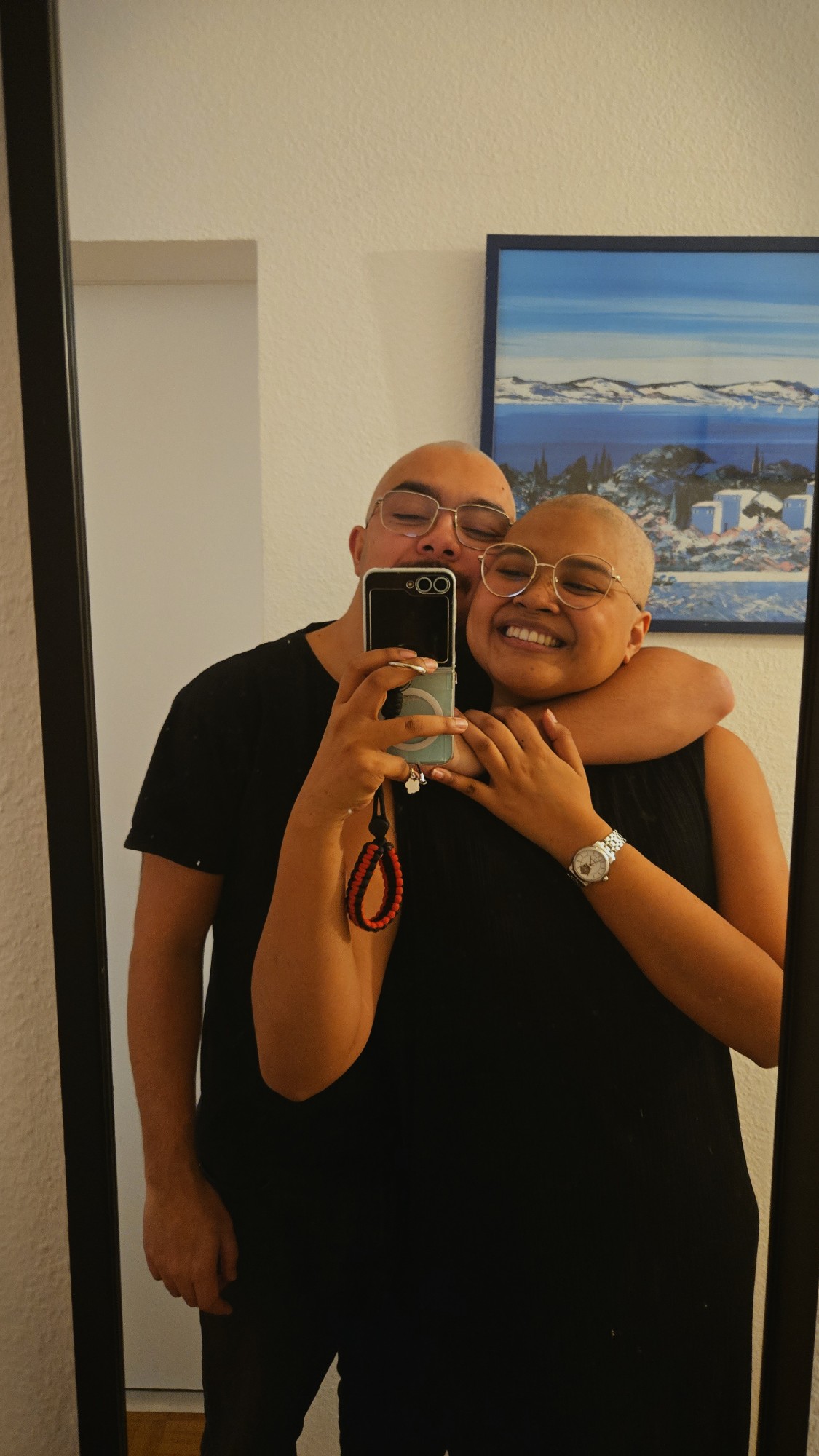
Mes cheveux ne repoussaient pas d’un coup parce que la dernière perfusion était terminée.

La fatigue ne disparaissait pas en retirant une date du calendrier.

Les douleurs ne savaient pas que j’avais fini.

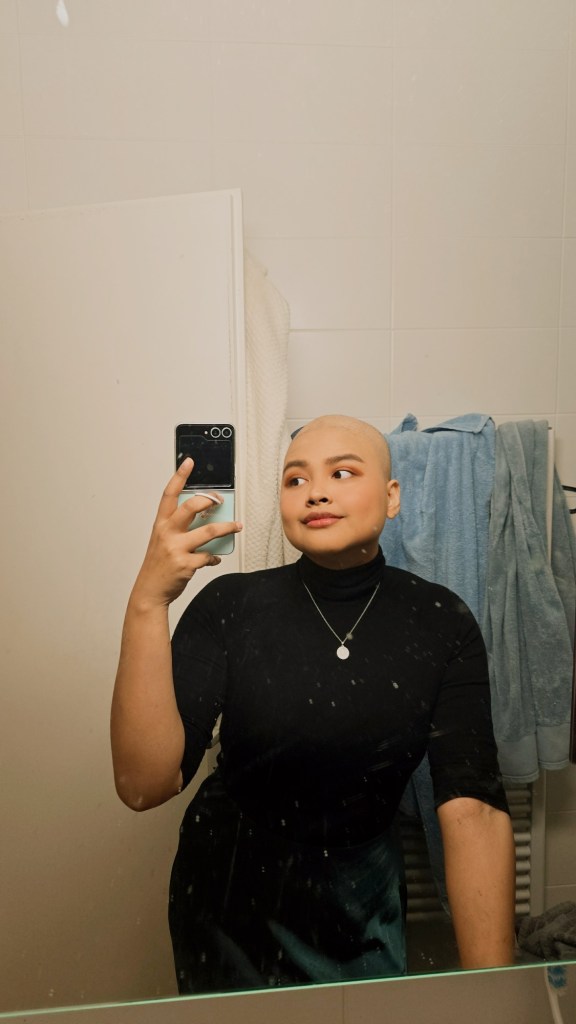
Mon reflet non plus.

Et ma tête encore moins.

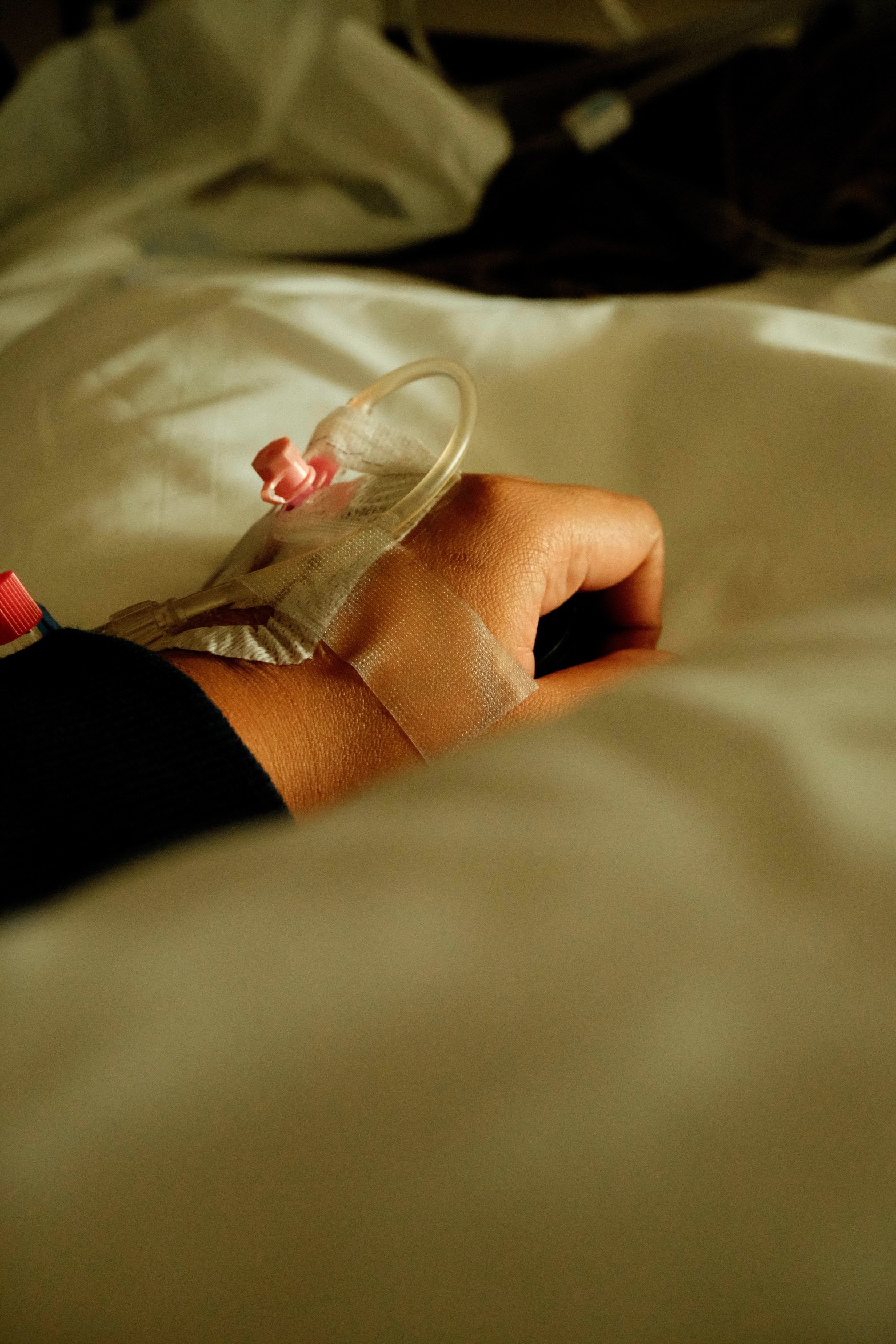
J’avais passé des mois à laisser entrer dans mon corps des produits qui devaient me sauver tout en me rendant malade.

J’avais accepté les aiguilles.

Les perfusions.

Les nausées.

La fatigue.

La perte de mes cheveux.

Les changements de mon corps.

Tout cela pour une vie que, certains jours, je n’étais même pas certaine de vouloir garder.

Et pourtant, j’étais arrivée jusqu’à la dernière perfusion.

Je ne savais toujours pas exactement ce que cela disait de moi.

Que je voulais vivre ?

Que j’avais simplement obéi au protocole ?

Que j’avais continué parce que les gens autour de moi espéraient que je continue ?

Peut-être un peu de tout cela.

Peut-être rien de tout cela.

Je savais seulement que j’étais encore là.

Deux jours plus tard, le 3 avril, on m’a retiré mon PAC.

Encore quelque chose qu’on enlevait de mon corps.

Pendant des mois, cette petite chambre sous ma peau avait été une porte d’entrée vers les traitements.

Je l’avais détestée.

Elle m’avait aussi provoqué une thrombose veineuse profonde sous-claviculaire.

C’est pour ça qu’on me l’a retirée un peu plus tôt que prévu.

Mais l’enlever ne suffisait pas à tout régler.

Ça avait ajouté des traitements.

Des anticoagulants.

Un manchon à porter.

Hiver comme été.

Encore des contraintes dans mon quotidien.

Encore des choses à accepter, à faire, à supporter.

Tout ça sans que j’aie rien demandé.

Je terminais la chimiothérapie, mais je ne pouvais pas simplement laisser tout cela derrière moi.

Le PAC était retiré.

Il restait une cicatrice.

Et les conséquences de ce qu’il avait provoqué.

Les traitements, eux, continuaient.

Le 24 avril, j’ai commencé la radiothérapie.

Vingt-cinq séances.

Cinq semaines.

Une nouvelle routine.

Cette fois, il n’y avait plus les longues heures de perfusion.

Il n’y avait plus les poches suspendues au-dessus de moi.

Plus cette attente particulière de la chimiothérapie.

La radiothérapie était différente.

Plus rapide.

Presque banale, vue de l’extérieur.

Entrer.

Se changer.

S’allonger.

Se positionner exactement comme il fallait.

Ne plus bouger.

Laisser la machine tourner autour de moi.

Puis se rhabiller.

Et repartir.

Quelques minutes seulement.

Puis revenir le lendemain.

Et encore le lendemain.

Et encore.

Le traitement prenait moins de temps.

Mais la maladie occupait toujours mes journées.

Chaque rendez-vous me rappelait que ce n’était pas terminé.

Chaque passage dans l’hôpital me ramenait à cette même réalité.

J’étais toujours une patiente.

Toujours en traitement.

Toujours entre deux versions de ma vie.

Celle d’avant n’existait plus vraiment.

Et celle d’après n’avait pas encore commencé.

Alors j’avançais dans cet espace étrange.

Pas assez malade pour que tout s’arrête.

Pas assez guérie pour recommencer.

Vingt-cinq séances.

Sur le papier, c’était un chiffre.

Dans ma vie, c’étaient les allers-retours.

Tous les jours de traitement.

Pour quelques minutes sur une table, il fallait repartir, revenir, et recommencer le lendemain.

Et pendant ce temps, la fatigue s’accumulait.

Un jour après l’autre.

Mais pendant ces semaines, j’avais rencontré une dame dans la salle d’attente.

Elle avait été un amour.

Une aide.

Un soutien dans ces moments-là.

Elle s’arrangeait pour que nos heures de passage soient à peu près les mêmes.

Comme ça, on se croisait.

On allait prendre un café.

Au milieu de ces rendez-vous que je subissais, il y avait aussi quelqu’un que j’avais plaisir à retrouver.

Puis je suis arrivée à la vingt-cinquième séance.

La dernière.

J’étais épuisée.

Arriver à la dernière ne rendait pas cette journée plus facile.

Et puis il y avait cette cloche.

La cloche de « fin de traitement ».

Elle avait envie de la sonner.

Moi, j’avais des appréhensions.

Est-ce que j’avais vraiment le droit de dire que c’était fini ?

Il y avait encore l’hormonothérapie.

Encore des traitements à suivre.

Je savais que je n’en avais pas terminé.

Alors, qu’est-ce que cette cloche allait annoncer pour moi ?

J’avais envie de lui faire plaisir, aussi.

Et j’essayais de me dire que les gros traitements étaient terminés.

Que je pouvais reconnaître cette étape, même si d’autres m’attendaient.

J’avais reçu quatre EC.

Douze Taxol.

Traversé vingt-cinq séances de radiothérapie.

J’étais arrivée jusque-là.

Et pendant tout ce temps, je m’étais aussi battue avec moi-même.

Ça avait été très, très dur.

Cette bataille-là n’avait pas de dernière séance inscrite dans le calendrier.

Mais elle faisait partie de tout ce qu’il m’avait fallu traverser pour être là, devant cette cloche.

Alors je l’ai sonnée.

Avec mes doutes.

Avec ma fatigue.

Sans être certaine de ce que le mot « fin » voulait dire.

Je méritais de la sonner.

Même si tout n’était pas terminé.
Chapter 10 – the hands that stayed

Illness doesn’t only reveal what a body can endure.

It reveals people, too.

There are those who show up.

Those who stay.

Those who try.

Those who don’t know what to say but say something anyway.

Those who promise they’ll be there—and actually are.

And then there are those who disappear.

Not always suddenly.

Sometimes, no one slams the door.

There is no argument.

No final conversation.

Just one less message.

Then another.

A visit that was supposed to happen, but never does.

A “see you soon” that eventually stops having a date attached to it.

And one day, you realize that someone who used to be part of your life is barely part of it anymore.

Illness does that sometimes.

It brings some people closer and pushes others away.

And it doesn’t always choose the ones you expected.

I received messages from people I never thought I would hear from.

Colleagues.

Acquaintances.

People I wasn’t necessarily particularly close to.

They could easily have gone on with their lives without writing to me.

And yet, they took a few minutes.

A few words.

I’m thinking of you.

How are you?

Stay strong.

Maybe it was only a message sent in between two things in their own day.

But on my side, sometimes it arrived on a day when my world had become very small.

So it mattered.

I discovered that people don’t all stay in the same way.

Some stay in waiting rooms.

Others around a table.

Some bring food.

Others suggest a trip.

Some write.

Some make you laugh.

Some have absolutely no idea what to do, so they simply do what they can.

And sometimes, staying means nothing more than slowing your pace so that the person who is ill can keep walking alongside everyone else.

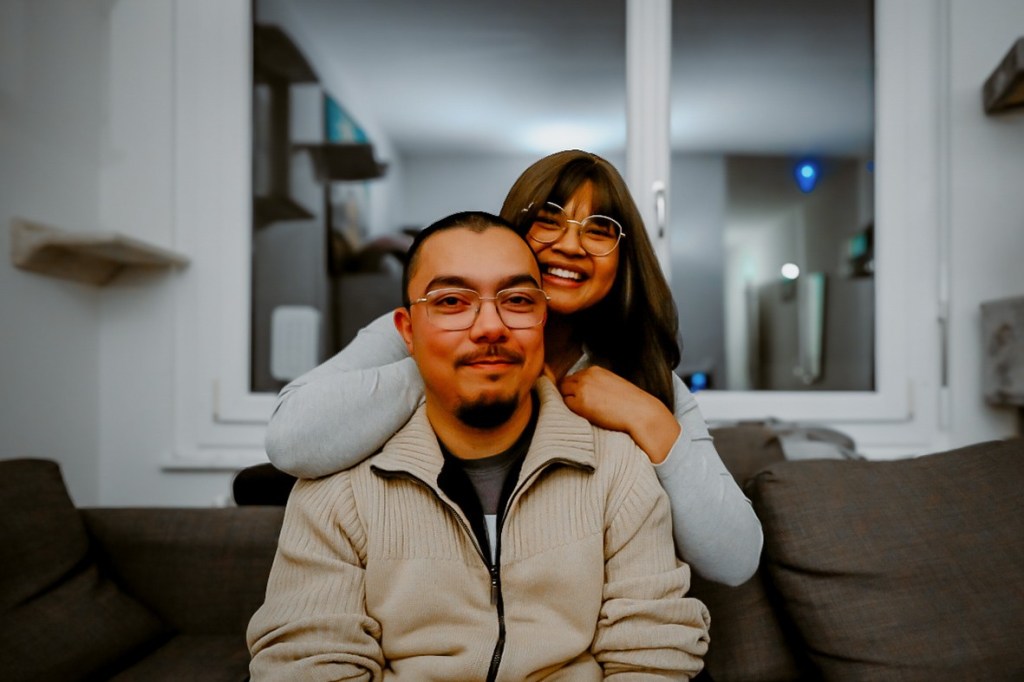
J.L. held a different place in my life. He was my partner, and despite everything the illness had changed between us, there was still this “us” I wanted to hold on to. Cancer had already taken up so much space in our daily lives, in our plans, and in what my body allowed us—or no longer allowed us—to do that I wanted to believe there was still something waiting for us afterward. A life to find again. Plans to pick back up. Places to go. Days that would no longer be organized around illness. Some days, I wanted to live for both of us. Because he was there, because he continued to believe there was an after, and because I wanted us to be able to look back on all of this one day. When I couldn’t find a reason to keep going for myself, sometimes our relationship gave me one.

But that same presence created an almost constant sense of guilt. The more I saw everything the illness was forcing him to endure, the more I wondered what it was taking from him, too. I didn’t want to become a responsibility, or for our relationship to be reduced to one sick person and another who had to be strong enough for two. And so the thought would turn against me: I wanted to live for both of us, but I could also convince myself that he would have a better life without me. I wanted to stay to thank him for staying, and sometimes I wanted to disappear so I would no longer be a burden. It was absurd, and yet it felt completely real inside my head. Love and guilt had somehow taken root in the same place. And depending on the day, I never knew which one would weigh more heavily.

Then there were my friends.

Sabrina and Kirsty had their own way of reminding me that my life didn’t end with my treatments. They kept inviting me over for meals, suggesting outings, creating simple moments where I could talk, laugh, and become their friend again before being a sick person. Sabrina also kept planning trips whenever my health and treatment schedule allowed it. She knew perfectly well that I was ill and adapted to what I could manage, but she refused to put everything on hold until it was over. When we shared a room, I could take off my wig or my beanie, try different ones on in front of her, and sometimes even laugh about it. With them, I found something that resembled my old life. I was grateful that they continued to include me, to make plans with me, to remind me that I was still capable of experiencing something other than cancer. They didn’t pretend that nothing had changed. They simply tried to make sure that not everything did.

But even those happy moments had another side to them. Every invitation could also remind me of everything I was no longer sure I could do. I was afraid of having to cancel at the last minute, of being too tired, of not making it through an entire day, or of a trip planned around me becoming more complicated for everyone else. I was grateful that they adapted, but sometimes frustrated that they had to. I wanted to enjoy myself without calculating my energy, to walk without wondering how long my body would keep up, to accept an invitation without first having to check my treatment schedule. And beneath all of that, the guilt would return: the guilt of slowing people down, of complicating things, of indirectly asking others to change their plans for me. They never made me feel like a burden. Most of the time, I was the one who made myself feel that way. The more they tried to help me keep living normally, the more I sometimes realized just how much my normal had changed.

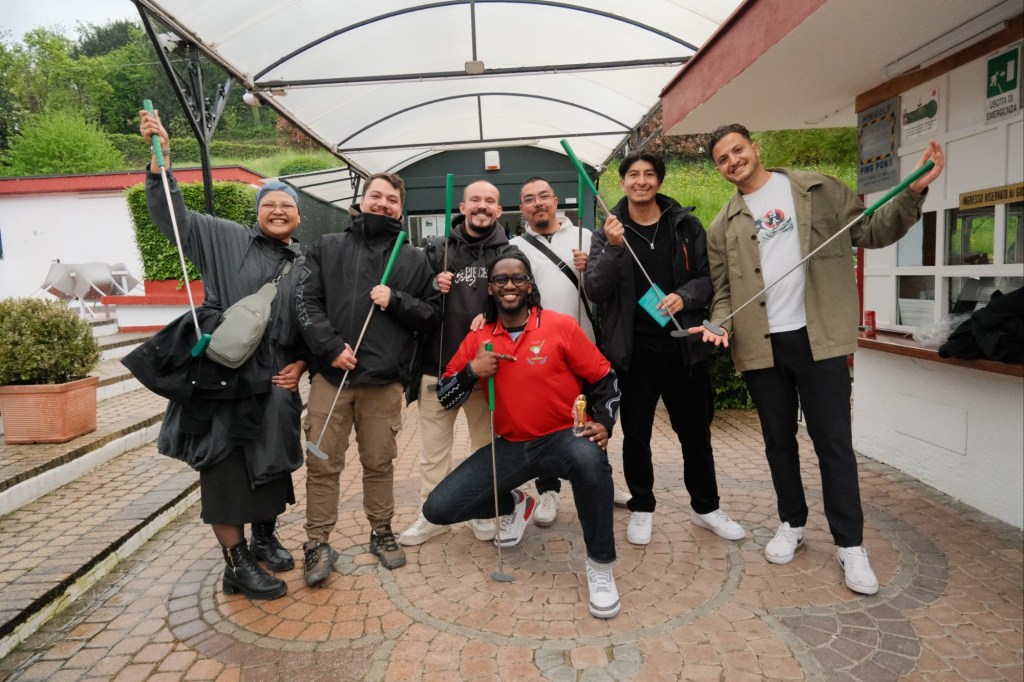
There were also J.L.’s friends, who, over the years, had become mine too. With them, there were card games, board games, evenings around a table, and a kind of kindness that never needed to be explained. I could take off my beanie or my wig without feeling people’s eyes change. The game continued. So did the conversations. We also went to Italy together: a day in Aosta, then Turin, sharing rooms, walking around and discovering the city, enjoying the beautiful weather and playing mini-golf. When I walked more slowly, they slowed down. No one made a big deal out of it. And I was deeply grateful for the way they acknowledged the illness without reducing me to it. With them, I could still have my place around a table, in a shared room, on a trip, within a group. The illness had changed my appearance and what I was physically capable of, but it hadn’t changed the way they welcomed me.

And yet, even then, I noticed everything. I noticed when the group slowed down because I could no longer keep up. I noticed the adjustments, even when they were made so naturally that no one pointed them out. And sometimes, it hurt. Not because of them, but because every kind gesture could become a reminder of something my body could no longer do the way it used to. I was afraid of ruining an outing, of tiring everyone else out, of becoming the person everyone had to wait for or the person everything had to be organized around. Sometimes, I wanted to tell them to keep going without me rather than watch them slow down. And at the same time, it would have hurt if they actually had. That was the contradiction of it all: wanting people to take my limitations into account without wanting those limitations to take up space; wanting them to wait for me while being unable to bear the idea of being the one everyone was waiting for. Their kindness comforted me, but it could also confront me with everything the illness had changed in me.

Then there was J.L.’s family. Over the years, they had become a little like my family too. I didn’t feel like I was simply “J.L.’s girlfriend,” invited because I happened to be part of the couple; I had my own place among them. And the illness hadn’t changed that. Birthdays, celebrations, and family gatherings continued, and I was always invited. They knew I could arrive feeling fine and be completely exhausted a few hours later, so there was always a room where I could lie down if I needed to. I could disappear for a while, sleep, and then come back to join everyone if my body allowed it. No one made me choose between being present and respecting my limits. I was grateful for that simplicity, but even more for what it represented: even while I was sick, I was still part of the family. There was a place for me around the table, but also a place for my exhaustion when I could no longer stay there.

And yet, once again, that gratitude came with something else. I noticed the adjustments. I knew a room was being kept available because I was there, that my energy could change the course of a day, and that sometimes people had to wonder whether I would be able to manage. Even though they never made me feel as though it bothered them, I sometimes felt like I was bringing the illness with me into moments that should simply have been happy. I was afraid people would worry, that they would watch me to make sure I was okay, that my exhaustion would become one more thing for them to think about. Sometimes, I wanted to stay with everyone simply so I wouldn’t be the one who had to go lie down again. And when I finally gave in and went to rest, there was that frustration of feeling my body take something away from me yet again. I was grateful that they gave me the possibility to rest without ever questioning my place among them, but I wished I didn’t need that special place to be made for me at all. It was the same contradiction again: being deeply grateful that people adapted to me while dreaming of no longer being the person everyone had to adapt to.

And then there were the healthcare professionals.

All of them.

The oncologists, surgeons, doctors, nurses, physiotherapists, but also the psychiatrists, psychologists, and every person who, at one point or another, tried to take care of some part of me. Some were treating my cancer, others the body damaged by the treatments, and others still were trying to care for what was happening inside my mind while everyone else was trying to save the rest of me. Over the months, I met so many of them that sometimes I can no longer remember all their names. But I remember the gestures. A blanket brought to me without my having to ask. A joke at exactly the right moment. An explanation repeated when I hadn’t fully understood. A question asked with enough patience to wait for the real answer. I also remember the ones in front of whom I could admit that I wasn’t okay without immediately having to pretend otherwise. In the middle of protocols, medications, tests, and appointments, I was grateful for every person who reminded me that behind the medical file, there was still a human being.

That gratitude was different from what I felt toward the people close to me. I hadn’t chosen these people, and they hadn’t chosen me either. Our paths had simply crossed because, at some point in my life, I needed them. To some of them, I entrusted my body, my scars, and my pain. To others, I entrusted thoughts I couldn’t always say anywhere else—my fears, my anger, my exhaustion, and all the contradictions living inside my head. Some were trying to repair what could still be repaired physically; others were simply helping me through what no one could see. There was something strange about that closeness with people who sometimes knew so little about my life and yet had witnessed some of its most fragile parts. Some names may eventually fade from my memory, but not the way I was cared for. Because in the middle of a time when I often felt like I no longer knew what to do with my own body or my own life, there were all these people who, each in their own way, continued to take care of both.

And despite all those people, there was loneliness.

That was probably one of the hardest things for me to understand.

I was surrounded.

Truly.

I had J.L., my friends, his family who had also become mine, the healthcare professionals, the messages, the invitations, the meals, the trips—all those people trying, each in their own way, to make that time a little less difficult.

I couldn’t say that I was alone.

And yet, I could feel terribly lonely.

For a long time, that contradiction made me feel guilty too. How could I feel so lonely when so many people were there? As though feeling lonely meant saying they weren’t doing enough. As though my sadness erased their efforts or made my gratitude less sincere. So sometimes, I kept that feeling to myself. I told myself I had no right to complain about loneliness when I was lucky enough to be surrounded by people.

But eventually, I understood that both could exist at the same time.

Being surrounded didn’t mean anyone could feel what I was feeling.

No one could inhabit my body for me.

No one could feel exactly that exhaustion, that fear, that anger, or all the thoughts that kept going once the conversations were over and everyone had gone home.

Someone could come with me to an appointment, sit beside me, walk more slowly to stay at my pace, listen to whatever I managed to put into words.

But there was always a part of the journey I had to walk alone.

And maybe that was what the loneliness of illness really looked like.

Not an empty room.

Not the absence of love.

But that invisible distance between what other people could see and everything that was actually happening inside me.

They could be there without being able to reach all the way in.

And it was no one’s fault.

The people who loved me couldn’t take my place.

The healthcare professionals couldn’t fix everything.

My friends couldn’t make my thoughts disappear simply by making me laugh.

J.L. couldn’t carry what I could no longer carry myself.

All they could do was stay.

And many of them did.

With time, I understood that this alone was immense.

There were also those who had drifted away. Some people became less present, some messages eventually stopped coming. I will probably never know exactly why. Maybe illness frightened them. Maybe some simply didn’t know what to say or how to behave in the face of something they couldn’t fix. Some absences hurt, especially when they came from people I thought would stay.

But illness also gave me the opposite.

People I had expected almost nothing from came closer. Colleagues, acquaintances, sometimes someone I thought was far removed from my life, who simply took the time to ask how I was doing.

Cancer had created a strange kind of sorting around me.

Some hands I thought were strong had let go.

Others, ones I had never imagined reaching for, had reached out to me.

And then there were the ones that had been there from the beginning.

None of them could walk the path in my place.

But they could walk beside me for as long as they were able.

So I kept going.

Not only because of them.

Not only for them.

But certainly not without them.

And while I kept going, the number of treatments kept getting smaller.

One less.

Then another.

After months of counting everything I still had left to endure, I began counting what separated me from the end.

And for the first time in a long time, that end actually felt close.

I thought I knew what it meant.

Finishing treatment.

Turning the page.

Getting my life back.

I didn’t know yet that you could reach the end of something without necessarily knowing what to do with what comes after.

Chapter 9 — The Body That No Longer Belonged to Me


On January 21, 2025, I started Taxol.

Twelve weeks.

One session a week.

After EC, I already knew the chairs.

The blood tests.

The IVs.

The waiting.

The checks before every treatment.

I already knew how to walk into an oncology ward and hold out my arm almost automatically.

I had already lost my hair.

I had learned how to wear wigs, headscarves, scarves.

I had learned to look at my reflection differently.

Or rather, I had learned not to look at it too closely.

I thought I had already watched my body change enough.

But it kept changing.

Me trying to see if I can find the old me


Taxol came back every week.

One session had barely ended before the next one was already appearing on my calendar.

Twelve.

Then eleven.

Ten.

Nine.

You might think I was counting because I couldn’t wait to reach the end.

That wasn’t really it.

I counted because I needed something to count.

Because treatment had turned my life into a succession of numbers.

The doses.

The results.

The blood counts.

The appointments.

The weeks.

The sessions left.

I kept going because the protocol kept going.

I showed up because an appointment had been scheduled.

They told me where to go.

When to come.

What to take.

So I went.

It probably looked like someone fighting to stay alive.

On the inside, it was different.

—

My body had changed so quickly that I hadn’t had time to understand what was happening to me.

A few months earlier, I still had both breasts.

My hair.

A body I could criticize for ordinary things.

Then it became medical.

It had been examined.

Photographed.

Measured.

Punctured.

Cut open.

Closed again.

Reconstructed.

Operated on again.

Hooked up to IVs.

Injected.

There was always someone who needed to look at something.

Touch something.

Check something.

A scar.

A vein.

A pain.

A result.

I knew why.

I knew all of it was being done to treat me.

But knowing that didn’t fill me with the kind of gratitude people sometimes imagine someone should feel when others are trying to save them.

I hated my body.

I hated what it had become.

I hated what had to be done to it.

And some days, I almost hated everything I was doing to keep taking care of it.

—

Before cancer, I had already spent a lot of time criticizing my body.

Too fat.

Not enough of this.

Too much of that.

A stomach I didn’t like.

A number on the scale that could ruin an entire day.

Details I gave far too much importance to.

Cancer didn’t teach me to love my body.

That would make a beautiful sentence.

But it would be a lie.

It gave me new reasons to hate it.

I no longer looked only at the things I thought were imperfect.

I looked at what had been removed.

What had been reconstructed.

What had changed.

What had fallen out.

What hurt.

What no longer worked the way it used to.

I looked at a body in which something had grown without my permission and turned the rest of my life upside down.

So no, I didn’t look at it and think:

Hold on.

I didn’t ask anything of it.

—

The mastectomy had already created a distance between my body and me.

Dressed, I could sometimes forget about it.

Undressed, much less so.

All it took was a mirror.

A scar.

A different shape.

A different sensation beneath my fingers.

I knew it was me.

Of course it was me.

But knowing that a body is yours and being able to recognize it as home are two different things.

Then my hair fell out.

And cancer became impossible to hide beneath my clothes.

Even my face had changed because I no longer looked at it the same way.

I could put on a wig.

Tie a scarf around my head.

Put on makeup.

Get dressed.

Do whatever I needed to do to look a little more like the person I had been before.

Then evening came.

Everything came off.

And there I was.

Well…

what was left of me.

—

People could look at what I was going through and see courage.

I mostly saw a succession of things I had never asked for.

I hadn’t asked for cancer.

I hadn’t asked to have a breast removed.

I hadn’t asked for the recurrence.

I hadn’t asked for a second surgery.

I hadn’t asked for chemotherapy.

I hadn’t asked to lose my hair.

I hadn’t asked to learn how to wear a wig at twenty-seven.

And above all,

I had never asked my body to hold on.

It did.

That was all.

My heart kept beating.

My lungs kept breathing.

The treatments continued.

The appointments continued.

And I went along with it.

Sometimes almost mechanically.

It wasn’t courage.

It wasn’t a declaration of love for life.

It was continuing because the next step arrived before I’d even had time to decide what I truly wanted.

—

Maybe that was the hardest thing to make people understand.

I was receiving treatment meant to save me without being sure I wanted to be saved.

From the outside, my actions said:

I want to live.

I went to my appointments.

I took my medication.

I accepted the treatments.

I reported my symptoms.

But inside, I wasn’t thinking:

Save me.

Sometimes, I thought instead:

If my body gives up, at least I won’t be the one who chose it.

Chemotherapy could frighten me while, at the same time, part of me could hope it would be too much for my body to take.

That contradiction didn’t simply disappear because I kept showing up for treatment.

Quite the opposite.

It followed me all the way into the chair.

—

And then there was Jean-Louis.

He made that contradiction even more complicated.

Because he was there.

He had shaved his head before I lost my hair.

He had come with me during EC.

He had seen me throw up.

He had tried to get me to eat when I couldn’t keep anything down.

He had driven when I didn’t have the strength.

He had rearranged part of his life around something my body had caused.

And the more he took care of me, the more two completely opposite thoughts could exist inside me at the same time.

Stay for him.

And:

Set him free from you.

I didn’t want to die because he didn’t matter enough.

It was almost the opposite.

He mattered so much that I saw everything he was doing.

Everything he was enduring.

Everything my illness was forcing on him too.

So sometimes, his presence kept me here.

And sometimes, that very same presence fed my guilt.

I wanted to give him his life back.

I wanted him to stop having to watch what I ate.

To stop having to come with me.

To stop having to watch his partner be sick.

In my mind, sometimes there were only two ways for that to happen.

Get better.

Or no longer be here.

And I wasn’t sure which one would happen first.

—

I hated this body.

But it kept going.

That was almost what angered me most.

Everyone seemed to be working to keep it going.

The oncologists.

The nurses.

The surgeons.

Jean-Louis.

The medication.

And me, in the middle of this enormous effort surrounding my own survival, not even knowing whether I wanted to take part in it.

So I let it happen.

One week.

Then another.

Taxol.

Again.

Again.

Again.

And every time I looked at my reflection, I was trying less to find the Arjelynne I had been before than to understand who this person standing in front of me was.

I didn’t see a warrior.

I didn’t see a survivor.

I certainly didn’t see someone who had learned to love her body because of cancer.

I saw someone tired.

Someone angry.

Someone who no longer recognized her own body.

Someone everyone was trying to keep alive when she herself was no longer sure she knew why.

My body kept moving through treatment.

I stayed somewhere behind.

And as the weeks went by, the distance between us only seemed to grow.

Chapitre 9 — Le corps qui ne m’appartenait plus

Le 21 janvier 2025, j’ai commencé le Taxol.

Douze semaines.

Une séance par semaine.

Après les EC, je connaissais déjà les fauteuils.

Les prises de sang.

Les perfusions.

Les attentes.

Les contrôles avant chaque traitement.

Je savais déjà comment entrer dans un service d’oncologie et tendre mon bras presque automatiquement.

J’avais déjà perdu mes cheveux.

J’avais appris les perruques, les foulards, les écharpes.

J’avais appris à regarder mon reflet autrement.

Ou plutôt, j’avais appris à éviter de trop le regarder.

Je pensais avoir déjà vu mon corps changer suffisamment.

Mais il continuait.

—

Le Taxol revenait toutes les semaines.

À peine une séance terminée qu’une autre commençait déjà à apparaître dans mon calendrier.

Douze.

Puis onze.

Dix.

Neuf.

On pourrait croire que je comptais parce que j’avais hâte d’arriver au bout.

Ce n’était pas vraiment ça.

Je comptais parce qu’il fallait bien compter quelque chose.

Parce que les traitements avaient transformé ma vie en une succession de chiffres.

Les doses.

Les résultats.

Les globules.

Les rendez-vous.

Les semaines.

Les séances restantes.

Je continuais parce que le protocole continuait.

Je me présentais parce qu’un rendez-vous était fixé.

On me disait où aller.

Quand venir.

Quoi prendre.

Alors j’y allais.

Cela ressemblait probablement à quelqu’un qui se battait pour vivre.

À l’intérieur, c’était différent.

—

Mon corps avait changé tellement vite que je n’avais pas eu le temps de comprendre ce qui m’arrivait.

Quelques mois auparavant, j’avais encore deux seins.

Mes cheveux.

Un corps que je pouvais critiquer pour des choses ordinaires.

Puis il était devenu médical.

On l’avait examiné.

Photographié.

Mesuré.

Piqué.

Ouvert.

Refermé.

Reconstruit.

Réopéré.

Perfusé.

Injecté.

Il y avait toujours quelqu’un qui devait regarder quelque chose.

Toucher quelque chose.

Contrôler quelque chose.

Une cicatrice.

Une veine.

Une douleur.

Un résultat.

Je savais pourquoi.

Je savais que tout cela était fait pour me soigner.

Mais cette connaissance ne provoquait pas chez moi cette gratitude que l’on imagine parfois chez quelqu’un que l’on essaie de sauver.

Je détestais mon corps.

Je détestais ce qu’il était devenu.

Je détestais ce qu’on devait lui faire.

Et certains jours, je détestais presque tout ce que je faisais pour continuer à le soigner.

—

Avant le cancer, j’avais déjà passé beaucoup de temps à critiquer mon corps.

Trop grosse.

Pas assez ceci.

Trop cela.

Un ventre que je n’aimais pas.

Un chiffre sur la balance capable de gâcher une journée.

Des détails auxquels j’accordais une importance démesurée.

Le cancer ne m’a pas appris à aimer mon corps.

Ce serait une jolie phrase.

Mais ce serait faux.

Il m’a donné de nouvelles raisons de le détester.

Je ne regardais plus seulement ce que je trouvais imparfait.

Je regardais ce qui avait été retiré.

Ce qui avait été reconstruit.

Ce qui avait changé.

Ce qui était tombé.

Ce qui faisait mal.

Ce qui ne fonctionnait plus comme avant.

Je regardais un corps dans lequel quelque chose avait poussé sans ma permission et avait bouleversé tout le reste de ma vie.

Alors non, je ne le regardais pas en pensant :

Tiens bon.

Je ne lui demandais rien.


La mastectomie avait déjà créé une distance entre lui et moi.

Habillée, je pouvais parfois l’oublier.

Déshabillée, beaucoup moins.

Il suffisait d’un miroir.

Une cicatrice.

Une forme différente.

Une sensation différente sous mes doigts.

Je savais que c’était moi.

Évidemment que c’était moi.

Mais savoir qu’un corps est le sien et réussir à le reconnaître comme son chez-soi sont deux choses différentes.

Puis mes cheveux étaient tombés.

Et le cancer était devenu impossible à ranger sous mes vêtements.

Même mon visage avait changé parce que je ne le regardais plus de la même manière.

Je pouvais mettre une perruque.

Nouer un foulard.

Me maquiller.

M’habiller.

Faire ce qu’il fallait pour ressembler un peu plus à celle que j’étais avant.

Puis venait le soir.

On retirait tout.

Et il restait moi.

Enfin…

ce qu’il restait de moi.

J’essayais de voir une moi d’avant

Les gens pouvaient regarder mon parcours et y voir du courage.

Moi, je voyais surtout une succession de choses que je n’avais jamais demandées.

Je n’avais pas demandé le cancer.

Je n’avais pas demandé qu’on m’enlève un sein.

Je n’avais pas demandé la récidive.

Je n’avais pas demandé une deuxième opération.

Je n’avais pas demandé la chimiothérapie.

Je n’avais pas demandé à perdre mes cheveux.

Je n’avais pas demandé à apprendre à porter une perruque à vingt-sept ans.

Et surtout,

je n’avais jamais demandé à mon corps de tenir.

Il le faisait.

C’est tout.

Mon cœur continuait de battre.

Mes poumons continuaient de respirer.

Les traitements continuaient.

Les rendez-vous continuaient.

Et moi, je suivais le mouvement.

Parfois presque mécaniquement.

Ce n’était pas du courage.

Ce n’était pas une déclaration d’amour à la vie.

C’était continuer parce que la prochaine étape arrivait avant même que j’aie eu le temps de décider ce que je voulais vraiment.

—

C’était peut-être ça, le plus difficile à faire comprendre.

Je recevais un traitement destiné à me sauver sans être certaine de vouloir être sauvée.

De l’extérieur, mes gestes disaient :

Je veux vivre.

Je venais aux rendez-vous.

Je prenais mes médicaments.

J’acceptais les traitements.

Je signalais mes symptômes.

Mais à l’intérieur, je ne pensais pas :

Sauvez-moi.

Il m’arrivait plutôt de penser :

Si mon corps lâche, au moins ce ne sera pas moi qui aurai choisi.

La chimiothérapie pouvait me faire peur et, en même temps, une partie de moi pouvait espérer qu’elle soit trop forte.

Ce paradoxe ne disparaissait pas simplement parce que je continuais à me présenter aux séances.

Au contraire.

Il m’accompagnait jusque dans le fauteuil.

—

Et puis il y avait Jean-Louis.

Lui compliquait encore cette contradiction.

Parce qu’il était là.

Il avait rasé ses cheveux avant moi.

Il m’avait accompagnée pendant les EC.

Il m’avait vue vomir.

Il avait essayé de me faire manger quand rien ne passait.

Il avait conduit quand je n’en avais pas la force.

Il avait organisé une partie de sa vie autour de quelque chose que mon corps avait provoqué.

Et plus il prenait soin de moi, plus deux pensées complètement opposées pouvaient exister en même temps.

Reste pour lui.

Et :

Libère-le de toi.

Je ne voulais pas mourir parce qu’il ne comptait pas suffisamment.

C’était presque l’inverse.

Il comptait tellement que je voyais tout ce qu’il faisait.

Tout ce qu’il supportait.

Tout ce que ma maladie lui imposait aussi.

Alors parfois, sa présence me retenait.

Et parfois, cette même présence nourrissait ma culpabilité.

Je voulais pouvoir lui rendre sa vie.

Je voulais qu’il n’ait plus à surveiller ce que je mangeais.

Qu’il n’ait plus à m’accompagner.

Qu’il n’ait plus à voir sa compagne malade.

Dans ma tête, il n’existait parfois que deux façons d’y parvenir.

Guérir.

Ou ne plus être là.

Et je n’étais pas certaine de laquelle arriverait en premier.

—

Je détestais ce corps.

Mais il continuait.

C’était presque cela qui m’énervait le plus.

Tout le monde semblait travailler pour qu’il continue.

Les oncologues.

Les infirmières.

Les chirurgiens.

Jean-Louis.

Les médicaments.

Et moi, au milieu de cette immense mobilisation autour de ma propre survie, je ne savais même pas si je voulais participer.

Alors je laissais faire.

Une semaine.

Puis une autre.

Taxol.

Encore.

Encore.

Encore.

Et chaque fois que je regardais mon reflet, j’essayais moins de retrouver l’Arjelynne d’avant que de comprendre qui était cette personne devant moi.

Je ne voyais pas une guerrière.

Je ne voyais pas une survivante.

Je ne voyais certainement pas quelqu’un qui avait appris à aimer son corps grâce au cancer.

Je voyais quelqu’un de fatigué.

Quelqu’un en colère.

Quelqu’un qui ne reconnaissait plus son propre corps.

Quelqu’un que tout le monde essayait de maintenir en vie alors qu’elle-même n’était plus certaine de savoir pourquoi.

Mon corps avançait dans le traitement.

Moi, je restais quelque part derrière.

Et plus les semaines passaient, plus la distance entre lui et moi semblait s’agrandir.

Chapitre 10 — Les mains qui restent

La maladie ne révèle pas seulement ce qu’un corps peut supporter.

Elle révèle aussi les gens.

Il y a ceux qui arrivent.

Ceux qui restent.

Ceux qui essaient.

Ceux qui ne savent pas quoi dire mais qui disent quand même quelque chose.

Ceux qui promettent d’être là et qui le sont réellement.

Et puis il y a ceux qui disparaissent.

Pas toujours brutalement.

Parfois, personne ne claque la porte.

Il n’y a pas de dispute.

Pas de dernière conversation.

Juste un message de moins.

Puis un autre.

Une visite qui devait se faire et qui ne se fait pas.

Un « on se voit bientôt » qui finit par ne plus avoir de date.

Et un jour, on réalise que quelqu’un qui faisait partie de notre vie n’en fait presque plus partie.

La maladie fait parfois cela.

Elle rapproche certaines personnes et en éloigne d’autres.

Et elle ne choisit pas toujours celles auxquelles on s’attendait.

J’ai reçu des messages de personnes dont je pensais ne jamais recevoir de nouvelles.

Des collègues.

Des connaissances.

Des gens avec lesquels je n’avais pas forcément une relation particulièrement proche.

Ils auraient très bien pu continuer leur vie sans m’écrire.

Et pourtant, ils ont pris quelques minutes.

Quelques mots.

Je pense à toi.

Comment tu vas ?

Courage.

Ce n’était peut-être qu’un message envoyé entre deux choses de leur propre journée.

Mais de mon côté, il arrivait parfois dans une journée où le monde était devenu très petit.

Alors il comptait.

J’ai découvert que les gens ne restent pas tous de la même manière.

Certains restent dans les salles d’attente.

D’autres autour d’une table.

Certains apportent à manger.

D’autres proposent un voyage.

Certains écrivent.

Certains font rire.

Certains ne savent absolument pas quoi faire, alors ils font simplement ce qu’ils peuvent.

Et parfois, rester consiste seulement à ralentir son pas pour que la personne malade puisse continuer à marcher avec les autres.

J.L., lui, occupait une place différente. Il était mon compagnon, et malgré tout ce que la maladie avait changé entre nous, il restait encore ce « nous » auquel j’avais envie de m’accrocher. Le cancer avait déjà pris tellement de place dans notre quotidien, dans nos projets et dans ce que mon corps nous permettait ou non de faire, que je voulais croire qu’il restait quelque chose après. Une vie à retrouver. Des projets à reprendre. Des endroits où aller. Des journées qui ne seraient plus organisées autour de la maladie. Certains jours, je voulais vivre pour nous deux. Parce qu’il était là, parce qu’il continuait à croire à un après, et parce que j’avais envie qu’un jour nous puissions regarder tout ça derrière nous. Quand je n’arrivais pas à trouver une raison de tenir pour moi-même, notre couple pouvait parfois m’en donner une.

Mais cette même présence faisait naître une culpabilité presque constante. Plus je voyais tout ce que la maladie lui imposait, plus je me demandais ce qu’elle lui prenait à lui aussi. Je ne voulais pas devenir une responsabilité, ni que notre couple se résume à une personne malade et à celle qui doit tenir pour deux. Alors la pensée se retournait contre moi : je voulais vivre pour nous deux, mais je pouvais aussi me convaincre qu’il vivrait mieux sans moi. Je voulais rester pour le remercier d’être resté, et parfois disparaître pour ne plus être un poids. C’était absurde et pourtant parfaitement réel dans ma tête. L’amour et la culpabilité avaient fini par pousser au même endroit. Et selon les jours, je ne savais jamais lequel des deux allait peser le plus lourd.

Puis il y avait les amis.

Sabrina et Kirsty avaient leur propre façon de me rappeler que ma vie ne s’arrêtait pas aux traitements. Elles continuaient à m’inviter à manger chez l’une ou chez l’autre, à proposer des sorties, à créer des moments simples où je pouvais parler, rire et redevenir leur amie avant d’être une personne malade. Sabrina continuait aussi à organiser des voyages dès que mon état et le calendrier des traitements le permettaient. Elle savait parfaitement que j’étais malade et s’adaptait à ce que je pouvais faire, mais elle refusait que tout soit mis en attente jusqu’à la fin. Quand nous partagions une chambre, je pouvais enlever ma perruque ou mon bonnet, en essayer d’autres devant elle, et parfois même en rire. Avec elles, je retrouvais quelque chose qui ressemblait à ma vie d’avant. J’étais reconnaissante qu’elles continuent à m’inclure, à prévoir des choses avec moi, à me rappeler que j’étais encore capable de vivre autre chose que le cancer. Elles ne faisaient pas semblant que rien n’avait changé. Elles essayaient simplement de faire en sorte que tout ne change pas.

Mais même ces moments heureux avaient leur envers. Chaque invitation pouvait aussi me rappeler tout ce que je n’étais plus certaine de pouvoir faire. J’avais peur de devoir annuler au dernier moment, d’être trop fatiguée, de ne pas tenir une journée entière ou qu’un voyage organisé autour de moi devienne plus compliqué pour les autres. J’étais reconnaissante qu’elles s’adaptent, mais parfois frustrée qu’elles aient besoin de le faire. Je voulais profiter sans calculer mon énergie, marcher sans me demander combien de temps mon corps allait suivre, accepter une invitation sans devoir d’abord consulter mon calendrier de traitements. Et derrière tout cela revenait cette culpabilité : celle de ralentir, de compliquer, de demander indirectement aux autres de modifier leurs plans pour moi. Elles ne me faisaient pas sentir comme un poids. Souvent, c’était moi qui me sentais ainsi. Plus elles faisaient en sorte que je puisse continuer à vivre normalement, plus je réalisais parfois à quel point ma normalité avait changé.

Il y avait aussi les amis de J.L., qui, avec les années, étaient devenus les miens. Avec eux, il y avait les jeux de cartes, les jeux de société, les soirées autour d’une table et cette bienveillance qui n’avait pas besoin d’être expliquée. Je pouvais enlever mon bonnet ou ma perruque sans sentir les regards changer. La partie continuait, les conversations aussi. C’est avec eux que nous sommes également partis en Italie : une journée à Aoste, puis Turin, les chambres partagées, les promenades pour découvrir la ville, le beau temps et le mini-golf. Quand je marchais moins vite, ils ralentissaient. Personne n’en faisait toute une histoire. Et j’étais profondément reconnaissante pour cette façon qu’ils avaient de tenir compte de la maladie sans me réduire à elle. Avec eux, je pouvais encore avoir ma place autour d’une table, dans une chambre partagée, dans un voyage, dans un groupe. La maladie avait changé mon apparence et mes capacités, mais elle n’avait pas changé la façon dont ils m’accueillaient.

Et pourtant, là aussi, je remarquais tout. Je remarquais quand le groupe ralentissait parce que je n’arrivais plus à suivre. Je remarquais les adaptations, même lorsqu’elles étaient faites avec tellement de naturel que personne ne les soulignait. Et parfois, cela me faisait mal. Pas à cause d’eux, mais parce que chaque geste bienveillant pouvait devenir le rappel de quelque chose que mon corps ne savait plus faire comme avant. J’avais peur de gâcher une sortie, de fatiguer les autres, de devenir celle qu’il fallait attendre ou celle autour de laquelle il fallait organiser les choses. Par moments, j’aurais voulu leur dire de continuer sans moi plutôt que de les voir ralentir. Et en même temps, j’aurais eu mal s’ils l’avaient réellement fait. C’était toute la contradiction : vouloir qu’on tienne compte de mes limites sans vouloir que mes limites prennent de la place ; vouloir qu’on m’attende sans supporter l’idée d’être celle qu’on attend. Leur bienveillance me faisait du bien, mais elle pouvait aussi me confronter à tout ce que la maladie avait changé en moi.

Puis il y avait la famille de J.L. Au fil des années, elle était devenue un peu la mienne aussi. Je n’avais pas seulement l’impression d’être « la copine de J.L. » invitée parce qu’elle faisait partie du couple ; j’avais ma propre place auprès d’eux. Et la maladie n’avait pas changé cela. Les anniversaires, les fêtes et les moments en famille continuaient, et j’étais toujours invitée. Ils savaient que je pouvais arriver en forme et être épuisée quelques heures plus tard, alors il y avait toujours une chambre où je pouvais aller m’allonger si j’en avais besoin. Je pouvais disparaître un moment, dormir, puis revenir rejoindre les autres si mon corps me le permettait. Personne ne me demandait de choisir entre être présente et respecter mes limites. J’étais reconnaissante pour cette simplicité, mais surtout pour ce qu’elle représentait : même malade, je faisais toujours partie de la famille. Il y avait une place pour moi autour de la table, mais aussi une place pour ma fatigue lorsque je ne pouvais plus y rester.

Et pourtant, là encore, cette gratitude venait avec autre chose. Je voyais les adaptations. Je savais qu’une chambre était gardée disponible parce que j’étais là, que mon énergie pouvait changer le déroulement d’une journée et que parfois il fallait se demander si j’allais tenir. Même lorsqu’ils ne me faisaient jamais sentir que cela les dérangeait, moi, je pouvais avoir l’impression d’apporter la maladie avec moi dans des moments qui auraient dû être simplement heureux. J’avais peur qu’on s’inquiète, qu’on surveille si j’allais bien, que ma fatigue devienne une préoccupation supplémentaire. Parfois, je voulais rester avec tout le monde simplement pour ne pas être celle qui devait encore aller se coucher. Et lorsque je finissais par céder et aller m’allonger, il y avait cette frustration de sentir que mon corps me retirait encore quelque chose. J’étais heureuse qu’ils me donnent la possibilité de me reposer sans jamais remettre en question ma place parmi eux, mais j’aurais préféré ne pas avoir besoin qu’on me fasse cette place particulière. C’était encore la même contradiction : être profondément reconnaissante qu’on s’adapte à moi, tout en rêvant de ne plus être celle pour qui il fallait s’adapter.

Et puis il y avait les soignants. Tous les soignants. Les oncologues, les chirurgiens, les médecins, les infirmiers et infirmières, les physiothérapeutes, mais aussi les psychiatres, les psychologues et toutes les personnes qui, à un moment ou à un autre, ont essayé de prendre soin d’une partie de moi. Certains s’occupaient de mon cancer, d’autres de mon corps abîmé par les traitements, et d’autres encore de ce qui se passait dans ma tête pendant que tout le monde essayait de sauver le reste. Pendant des mois, j’en ai croisé tellement que je ne me souviens parfois plus de tous les noms. Pourtant, je me souviens des gestes. D’une couverture apportée sans que je la demande, d’une plaisanterie au bon moment, d’une explication répétée lorsque je n’avais pas tout compris, d’une question posée avec suffisamment de patience pour attendre la vraie réponse. Je me souviens aussi de ceux devant qui je pouvais dire que ça n’allait pas sans devoir immédiatement prétendre le contraire. Au milieu des protocoles, des médicaments, des examens et des rendez-vous, j’étais reconnaissante pour chaque personne qui me rappelait que derrière le dossier médical, il y avait encore quelqu’un.

Cette gratitude était différente de celle que je ressentais envers mes proches. Je n’avais pas choisi ces personnes et elles ne m’avaient pas choisie non plus. Nos chemins s’étaient simplement croisés parce qu’à un moment de ma vie, j’avais eu besoin d’elles. À certaines, j’ai confié mon corps, mes cicatrices et mes douleurs. À d’autres, des pensées que je n’arrivais pas toujours à dire ailleurs, mes peurs, ma colère, mon épuisement et toutes les contradictions qui vivaient dans ma tête. Certaines essayaient de réparer ce qui pouvait l’être physiquement ; d’autres m’aidaient simplement à traverser ce qui ne se voyait pas. Il y avait quelque chose d’étrange dans cette proximité avec des personnes qui connaissaient parfois si peu de ma vie et qui, pourtant, en avaient vu certaines des parties les plus fragiles. Certains noms finiront peut-être par s’effacer de ma mémoire, mais pas la façon dont on a pris soin de moi. Parce qu’au milieu d’une période où j’avais souvent l’impression de ne plus savoir quoi faire de mon propre corps ni de ma propre vie, il y avait toutes ces personnes qui, chacune à leur manière, continuaient à prendre soin des deux.

Et malgré toutes ces personnes, il y avait la solitude.

C’est probablement l’une des choses que j’ai eu le plus de mal à comprendre. J’étais entourée. Vraiment. J’avais J.L., mes amis, sa famille qui était aussi devenue la mienne, les soignants, les messages, les invitations, les repas, les voyages, toutes ces personnes qui essayaient, chacune à leur manière, de rendre cette période un peu moins difficile. Je ne pouvais pas dire que j’étais seule. Et pourtant, je pouvais me sentir terriblement seule.

Pendant longtemps, cette contradiction m’a fait culpabiliser elle aussi. Comment pouvais-je ressentir autant de solitude alors que tant de personnes étaient présentes ? Comme si me sentir seule revenait à dire qu’elles n’en faisaient pas assez. Comme si ma tristesse annulait leurs efforts ou rendait ma gratitude moins sincère. Alors parfois, je gardais ce sentiment pour moi. Je me disais que je n’avais pas le droit de me plaindre de solitude puisque j’avais la chance d’être entourée.

Mais j’ai fini par comprendre que les deux pouvaient exister en même temps.

Être entourée ne voulait pas dire que quelqu’un pouvait ressentir ce que je ressentais. Personne ne pouvait habiter mon corps à ma place. Personne ne pouvait ressentir exactement cette fatigue, cette peur, cette colère ou toutes les pensées qui continuaient une fois que les conversations étaient terminées et que chacun rentrait chez soi. On pouvait m’accompagner à un rendez-vous, s’asseoir à côté de moi, marcher moins vite pour rester à mon rythme, écouter ce que j’arrivais à raconter. Mais il restait toujours une partie du chemin que je devais parcourir seule.

Et peut-être que la solitude de la maladie ressemblait surtout à ça.

Pas à une pièce vide.

Pas à l’absence d’amour.

Mais à cette distance invisible entre ce que les autres pouvaient voir et tout ce qui se passait réellement à l’intérieur de moi.

Ils pouvaient être là sans pouvoir entrer jusque-là.

Et ce n’était la faute de personne.

Les personnes qui m’aimaient ne pouvaient pas prendre ma place. Les soignants ne pouvaient pas tout réparer. Mes amis ne pouvaient pas faire disparaître mes pensées simplement en me faisant rire. J.L. ne pouvait pas porter ce que je n’arrivais déjà plus à porter moi-même.

Ils pouvaient seulement rester.

Et beaucoup sont restés.

Avec le temps, j’ai compris que c’était déjà immense.

Il y avait aussi ceux qui s’étaient éloignés. Certaines présences étaient devenues plus rares, certains messages avaient fini par s’arrêter. Je ne saurai probablement jamais exactement pourquoi. Peut-être que la maladie faisait peur. Peut-être que certains ne savaient simplement pas quoi dire ou comment se comporter face à quelque chose qu’ils ne pouvaient pas réparer. Certaines absences m’ont blessée, surtout lorsqu’elles venaient de personnes dont j’aurais pensé qu’elles resteraient. Mais la maladie m’a aussi réservé l’inverse : des personnes dont je n’attendais presque rien se sont rapprochées. Des collègues, des connaissances, parfois quelqu’un que je pensais loin de ma vie, qui prenait simplement le temps de demander comment j’allais.

Le cancer avait fait un étrange tri autour de moi.

Certaines mains que je pensais solides avaient lâché.

D’autres, auxquelles je n’avais jamais pensé m’accrocher, s’étaient tendues.

Et puis il y avait celles qui étaient restées depuis le début.

Aucune ne pouvait parcourir le chemin à ma place.

Mais elles pouvaient marcher à côté de moi aussi longtemps qu’elles le pouvaient.

Alors j’ai continué.

Pas uniquement grâce à elles.

Pas uniquement pour elles.

Mais certainement pas sans elles.

Et pendant que je continuais, les séances, elles, diminuaient.

Une de moins.

Puis une autre.

Après des mois à compter tout ce qu’il me restait encore à traverser, j’ai commencé à compter ce qui me séparait de la fin.

Et pour la première fois depuis longtemps, cette fin semblait réellement proche.

Je pensais savoir ce qu’elle signifiait.

Finir les traitements.

Tourner la page.

Reprendre ma vie.

Je ne savais pas encore qu’on pouvait arriver au bout de quelque chose sans forcément savoir quoi faire de l’après.

Chapter 8 — Starting Over

I thought the hardest part would be finding out that the cancer had come back.

I was wrong.

The hardest part was realizing that everything was going to start all over again.

The appointments.

The blood tests.

The waiting rooms.

The doctors speaking in that calm voice you eventually learn to recognize.

The medical words you slowly begin to understand, even though you never wanted to learn them in the first place.

And that strange feeling of watching your own life turn into a treatment protocol.

My body had barely had time to fall silent after the second surgery before they were already talking about what came next.

This time, there would be chemotherapy.

I knew what that word meant.

Everyone does, in a way.

You think of hair falling out. Nausea. Exhaustion. IV drips. Pale faces you have seen in movies.

But knowing a word and understanding what it is going to do to your life are two completely different things.

Chemotherapy was about to begin.

And I wasn’t ready.

And yet, there was a truth I wasn’t really telling anyone.

I was afraid of chemotherapy.

But part of me was waiting for it too, for a much darker reason.

I hoped it would be strong.

Strong enough to completely exhaust me.

Strong enough that eventually, my body simply wouldn’t be able to keep going.

I knew exactly how contradictory that thought was: they were about to give me a treatment in the hope of saving my life, while somewhere in the silence of my own mind, I sometimes hoped it would do the opposite.

I hadn’t decided to stop treatment.

I kept showing up to my appointments.

I let the doctors do everything they needed to do to treat me.

But deep inside me, something had already become far less certain.

I wasn’t sure anymore whether I wanted to be saved.

Maybe that was the hardest part to explain.

I wanted to live.

And sometimes, I wanted to die.

Both could exist within the same day.

Sometimes within the same hour.

One reassuring result could make me breathe a little easier, and then one night that lasted too long could leave me wondering what the point of continuing was.

I think part of me simply wanted to no longer have to choose.

I wanted my body to choose for me.

If chemotherapy saved me, then maybe I would keep going.

And if my body couldn’t take it anymore…

at least I wouldn’t have been the one who decided.

—

People talk a lot about fighting cancer.

You have to fight.

You’re strong.

You can do this.

Don’t give up.

They were words spoken with love. I knew that.

But sometimes, I wanted to ask:

What if I’m tired of fighting?

No one asks a sick person whether they want to be brave.

You become brave because somehow, you have to keep moving.

I hadn’t chosen this war.

I hadn’t chosen my opponent.

I hadn’t even chosen the battlefield.

It was my own body.

And still, I had to start over.

The EC treatment is so tiring, I had to lay down during the treatment.


On November 26, 2024, I received my first chemotherapy treatment.

EC.

Two letters.

Two tiny letters for something that was about to take up so much space in my life.

Jean-Louis was with me.

He would be there for each of the four EC sessions.

At first, I didn’t know exactly how my body was going to react.

Then came the exhaustion.

Not simply feeling sleepy.

An exhaustion that seemed to take possession of my entire body.

The nausea.

The vomiting.

The moments when eating even a few bites became an ordeal.

Jean-Louis saw what the treatments were doing to me.

So he came.

He waited.

He drove me home.

When I was vomiting, he was there.

When I couldn’t eat, he tried to find something my body might accept.

When I no longer had the energy to do much of anything, he was still there.

Sometimes there was nothing he could fix.

But he stayed.

And back then, staying already meant so much.

And yet, his presence made that strange balance tip in both directions.

Because when he was beside me, part of me wanted to hold on.

For him.

For us.

So that one day, I could thank him in some way other than between treatments.

So that we could have our ordinary life back.

So that one day he wouldn’t have to check whether I had eaten, take me to another session, or see me exhausted on the sofa.

I wanted to survive so that I could somehow give back a little of everything he was giving me.

But the more he took care of me, the more another thought quietly began to grow.

I’m becoming a burden.

I watched him rearrange his days.

Come with me.

Wait.

Drive me around.

Watch me throw up.

Try to get me to eat.

Carry me through my worst days without knowing when they would end.

And I wondered how long someone could do all of that before they became exhausted too.

So, in my mind, the same person became both a reason to stay and a reason to want to disappear.

I wanted to live because he was there.

And sometimes, I thought dying would free him from everything he had to carry because of me.

The logic was cruel.

But at the time, it almost made sense to me.

Maybe that is one of the most vicious things darkness can do.

It can take the love we receive and somehow convince us that the people who love us would be better off if they no longer had to give it.

—

After my second EC treatment, my hair started falling out.

I was at some friends’ place when I noticed.

At first, just a few strands.

Then I ran my hand through my hair.

And they came away.

I stared at them in my palm, not really knowing what I was supposed to feel.

I did it again.

More.

And more hair.

My friends tried to reassure me.

It’s okay.

I knew what they meant.

It was “just” hair.

It would grow back.

It wasn’t what would determine whether I lived or died.

But that day, what I was staring at in the palm of my hand wasn’t just hair.

It was the disease becoming visible.

Until then, I could still walk into a room without people necessarily knowing.

The exhaustion wasn’t always visible.

Neither was the nausea.

And fear was even easier to hide.

But falling hair tells a story before you even open your mouth.

Cancer was beginning to speak for me.

—

And then Jean-Louis did something I have never forgotten.

Before I even shaved mine, he shaved his head.

First.

He could have simply told me it was okay.

That I was still beautiful.

That hair grows back.

Instead, he chose to do something.

A tiny gesture compared with everything that was happening to us.

And yet, enormous to me.

He couldn’t take the chemotherapy for me.

He couldn’t stop my hair from falling out.

He couldn’t remove the cancer from my body.

So he found something he could share with me.

When my turn came, I wasn’t quite as alone in front of that mirror.


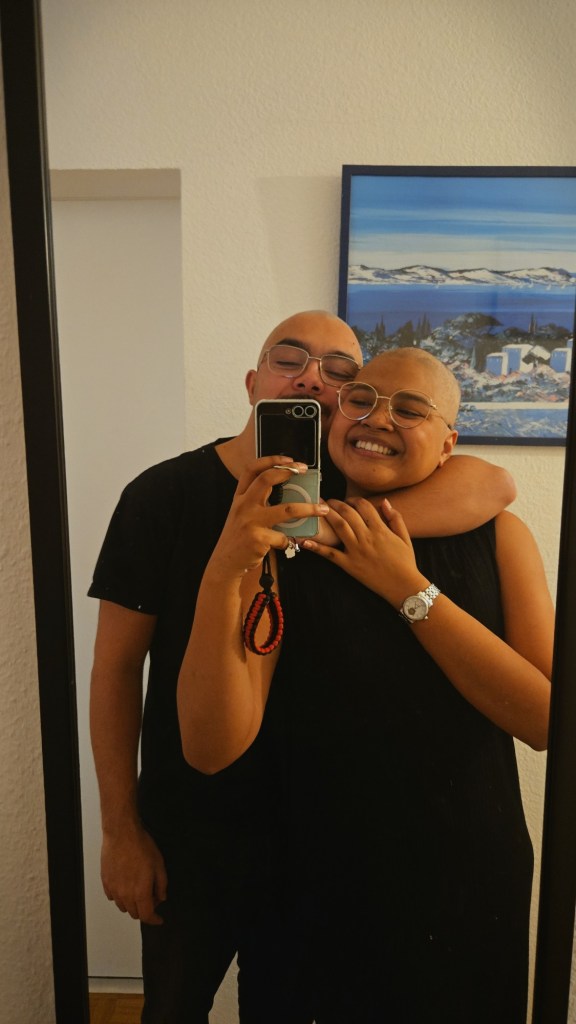
The after shaving our heads off

After that, I had to learn.

As though the disease had handed me a new instruction manual for myself.

How to put on a wig.

How to adjust it.

How to position it naturally enough that I wouldn’t feel as though everyone was looking at nothing but that.

I learned about headscarves.

Scarves.

All the different ways of tying them.

I learned what I liked.

What still felt a little like me.

What allowed me to leave the house without feeling as though I had the word cancer written across my forehead.

Some days, the wig helped.

It allowed me to find something familiar in the mirror.

Other days, it only reminded me why I needed it.

Everything had become like that.

Double-edged.

Even love.

—

Treatment began to dictate the rhythm of time.

There weren’t really Mondays, Tuesdays, or weekends anymore.

There were chemotherapy days.

The days after.

The days when I felt a little better.

And the days when I already had to start thinking about the next one.

My calendar no longer told the story of my life.

It told the story of my treatment.

And somewhere between appointments, I was still trying to exist.

One of those outing I can be okay

Not as a patient.

As myself.

I still wanted to laugh.

To talk about something else.

To take photographs.

To listen to music.

To have completely pointless conversations.

To complain about ordinary things.

Because there was something incredibly precious about being able to complain about a problem that had absolutely nothing to do with cancer.

For a few minutes, I was simply a twenty-seven-year-old woman.

Not a diagnosis.

Not a medical file.

Not a patient.

Arjelynne.

—

But my body knew.

It knew what was being done to it.

And gradually, it began to show me.

The exhaustion.

The pain.

The changes.

That feeling that every treatment took something with it.

I watched my body change with a strange sense of distance.

Almost as though I were observing it from the outside.

And yet, it was the body I had lived in my entire life.

The one I had sometimes loved.

Often criticized.

Rarely thanked.

And now I was asking it to endure even more.

It is strange how you can spend years criticizing so many things about your body…

and then find yourself begging that same body to hold on.

What made it even stranger was that some days, I genuinely begged it to keep going.

And on others, in the privacy of my own thoughts, I almost hoped it would stop.

Both truths existed at the same time.

I wanted to survive.

I wanted everything to stop.

I could be afraid of dying in the morning and exhausted by being alive that same evening.

And Jean-Louis stood somewhere in the middle of that contradiction.

His presence reminded me that there was still something waiting for me beyond treatment.

Our ordinary life.

Our apartment.

Our routines.

Our plans.

A life in which, perhaps, I wouldn’t always be sick.

But every time he had to help me up, wait for me, drive me somewhere, make sure I was eating, or stay beside me while I was vomiting, that other voice returned.

Look at everything he has to do because of you.

So I wanted to get better so I could give back everything he was giving me.

And sometimes, I wanted to disappear so that he would no longer have to give me anything at all.

Contradictory.

Exhausting.

But true.

—

I kept showing up.

Again.

And then again.

Four cycles of EC.

The last one was on January 7, 2025.

But it wasn’t over.

Of course it wasn’t.

On January 21, another stage began.

Twelve weeks of Taxol.

Twelve.

By then, numbers had started to lose their meaning.

One session.

Four sessions.

Twelve sessions.

You count a lot when you are sick.

The days.

The doses.

The pills.

The appointments.

The results.

The blood counts.

The weeks remaining.

As though putting numbers on things might give us the illusion of taking back a little control.

I counted too.

Because one treatment completed meant one less treatment left to endure.

I didn’t think about the months ahead.

Even less about the years.

Sometimes I reduced my entire life to the distance between me and my next appointment.

Just this session.

Then you can rest.

Just this week.

Maybe after that it will be easier.

Just a little longer.

Always just a little longer.

Because looking at the whole mountain might have been too much.

So I looked only at the next step.

I wasn’t moving forward because I was particularly brave.

I wasn’t moving forward because I believed everything would turn out all right.

I wasn’t even always moving forward because I wanted to live.

Sometimes I kept going simply because the next appointment was already written in my calendar.

Because Jean-Louis was waiting for me.

Because the doctors were waiting for me.

Because my body was still here.

Because somewhere in the middle of all those contradictory thoughts, some part of me kept showing up anyway.

I didn’t know whether it was strength.

Habit.

Fear.

Love.

Or simply instinct.

Maybe it was a little of everything.

I was caught between a disease that could take my life,

treatments trying to save it,

a man doing everything he could to help me hold on to it,

and me,

somewhere in the middle,

no longer quite sure which way I wanted the balance to tip.

So I didn’t look any further ahead.

I only had to make it to the next appointment.

And sometimes, surviving looked like nothing more than this:

showing up.

Again.

And again.

And again.

Chapitre 8 — Recommencer

Je pensais que le plus difficile serait d’apprendre que le cancer était revenu.

Je me trompais.

Le plus difficile, c’était de comprendre que tout allait recommencer.

Les rendez-vous.

Les prises de sang.

Les salles d’attente.

Les médecins qui parlent avec cette voix calme que l’on apprend à reconnaître.

Les mots médicaux que l’on finit par comprendre sans jamais avoir voulu les apprendre.

Et cette sensation étrange de voir sa propre vie se transformer en protocole.

Après la deuxième opération, mon corps n’avait même pas eu le temps de redevenir silencieux qu’on parlait déjà de la suite.

Cette fois, il y aurait la chimiothérapie.

Je savais ce que ce mot voulait dire.

Tout le monde le sait, d’une certaine manière.

On pense aux cheveux qui tombent. Aux nausées. À la fatigue. Aux perfusions. Aux visages pâles que l’on a vus dans les films.

Mais connaître un mot et comprendre ce qu’il va faire à votre vie sont deux choses complètement différentes.

La chimiothérapie allait commencer.

Et moi, je n’étais pas prête.

Pourtant, il y avait une vérité que je ne disais pas vraiment.

J’avais peur de la chimiothérapie.

Mais une partie de moi l’attendait aussi pour une raison beaucoup plus sombre.

J’espérais qu’elle soit forte.

Assez forte pour m’épuiser complètement.

Assez forte pour que mon corps finisse par ne plus pouvoir suivre.

Je savais parfaitement la contradiction de cette pensée : on était en train de me donner un traitement dans l’espoir de me sauver la vie et moi, quelque part dans le silence de ma tête, j’espérais parfois qu’il fasse l’inverse.

Je n’avais pas décidé d’arrêter les traitements.

Je continuais à me présenter aux rendez-vous.

Je laissais les médecins faire ce qu’il fallait pour me soigner.

Mais au fond de moi, quelque chose était déjà beaucoup moins certain.

Je ne savais plus vraiment si je voulais être sauvée.

C’était peut-être cela, le plus difficile à expliquer.

Je voulais vivre.

Et parfois, je voulais mourir.

Les deux pouvaient exister dans la même journée.

Parfois même dans la même heure.

Il suffisait d’un résultat rassurant pour que je respire un peu mieux, puis d’une nuit trop longue pour que je me demande à quoi bon continuer.

Je crois qu’une partie de moi espérait surtout ne plus avoir à choisir.

Que mon corps choisisse à ma place.

Si la chimiothérapie me sauvait, alors peut-être que je continuerais.

Et si mon corps n’en pouvait plus…

je n’aurais pas été celle qui avait décidé.

On parle beaucoup du combat contre le cancer.

Il faut se battre.

Tu es forte.

Tu vas y arriver.

Ne lâche rien.

Des phrases prononcées avec amour. Je le savais.

Mais parfois, j’avais envie de demander :

Et si je suis fatiguée de me battre ?

Personne ne demande au malade s’il veut être courageux.

On le devient parce qu’il faut bien avancer.

Je n’avais pas choisi cette guerre.

Je n’avais pas choisi mon adversaire.

Je n’avais même pas choisi le champ de bataille.

C’était mon propre corps.

Et pourtant, il fallait recommencer.

Je devais prendre les EC dans un lit car cela fatigue énormément.

Le 26 novembre 2024, j’ai reçu ma première chimiothérapie.

EC.

Deux lettres.

Deux petites lettres pour quelque chose qui allait prendre tellement de place dans ma vie.

Jean-Louis était avec moi.Il le serait pour chacune des quatre séances d’EC.

Au début, je ne savais pas encore exactement comment mon corps allait réagir.

Puis il y eut la fatigue.

Pas simplement l’envie de dormir.

Une fatigue qui semblait prendre possession du corps entier.

Les nausées.

Les vomissements.

Les moments où manger quelques bouchées devenait déjà une épreuve.

Jean-Louis voyait ce que les traitements me faisaient.

Alors il venait.

Il attendait.

Il me ramenait.

Quand je vomissais, il était là.

Quand je n’arrivais pas à manger, il essayait de trouver quelque chose que mon corps accepterait.

Quand je n’avais plus l’énergie de faire grand-chose, il était encore là.

Parfois, il ne pouvait rien réparer.

Mais il restait.

Et à cette époque, rester était déjà énormément.

Sa présence faisait pourtant pencher cette étrange balance dans les deux directions.

Parce que lorsqu’il était près de moi, une partie de moi voulait tenir.

Pour lui.

Pour nous.

Pour pouvoir un jour lui dire merci autrement qu’entre deux traitements.

Pour retrouver notre quotidien.

Pour qu’un jour il n’ait plus besoin de surveiller si j’avais mangé, de m’accompagner à une séance ou de me voir épuisée sur le canapé.

Je voulais survivre pour pouvoir lui rendre un peu de tout ce qu’il me donnait.

Mais plus il prenait soin de moi, plus une autre pensée grandissait silencieusement.

Je deviens un fardeau.

Je le voyais adapter ses journées.

M’accompagner.

Attendre.

Me conduire.

Me voir vomir.

Essayer de me faire manger.

Supporter mes mauvais jours sans savoir quand ils prendraient fin.

Et je me demandais combien de temps quelqu’un pouvait faire tout cela avant d’être épuisé à son tour.

Alors la même personne devenait, dans mon esprit, à la fois une raison de rester et une raison de vouloir disparaître.

Je voulais vivre parce qu’il était là.

Et parfois, je pensais que mourir le libérerait de tout ce qu’il devait porter avec moi.

Cette logique était cruelle.

Mais à ce moment-là, elle me paraissait presque cohérente.

C’est peut-être l’une des choses les plus perverses que les ténèbres puissent faire.

Prendre l’amour que l’on reçoit et réussir à nous convaincre que les autres seraient mieux sans avoir à nous le donner.

Après la deuxième EC, mes cheveux ont commencé à tomber.

J’étais chez des amis lorsque je m’en suis rendu compte.

Au début, quelques cheveux.

Puis j’ai passé ma main dedans.

Et ils sont venus.

Je les ai regardés dans ma paume sans vraiment savoir quoi ressentir.

J’ai recommencé.

Encore.

Et encore des cheveux.

Mes amis ont essayé de me rassurer.

Ce n’est pas grave.

Je savais ce qu’ils voulaient dire.

Ce n’étaient « que » des cheveux.

Ils repousseraient.

Ce n’était pas ce qui allait décider si je vivais ou si je mourais.

Mais ce jour-là, ce n’étaient pas seulement des cheveux que je regardais dans ma main.

C’était la maladie qui devenait visible.

Jusque-là, je pouvais encore entrer quelque part sans que les gens sachent forcément.

La fatigue ne se voyait pas toujours.

Les nausées non plus.

La peur encore moins.

Mais les cheveux qui tombent racontent quelque chose avant même que l’on ait ouvert la bouche.

Le cancer commençait à parler pour moi.


Et puis Jean-Louis a fait quelque chose que je n’ai jamais oublié.

Avant même que je rase les miens, il a rasé ses cheveux.

D’abord.

Il aurait pu simplement me dire que ce n’était pas grave.

Que j’étais toujours belle.

Que les cheveux repoussent.

Mais il a choisi de faire quelque chose.

Un geste minuscule face à tout ce qui nous arrivait.

Et pourtant immense pour moi.

Il ne pouvait pas prendre ma chimiothérapie à ma place.

Il ne pouvait pas empêcher mes cheveux de tomber.

Il ne pouvait pas enlever le cancer de mon corps.

Alors il avait trouvé quelque chose qu’il pouvait partager avec moi.

Lorsque mon tour est arrivé, je n’étais plus tout à fait seule devant ce miroir.

Après photo

Après, il a fallu apprendre.

Comme si la maladie m’avait donné un nouveau mode d’emploi de moi-même.

Apprendre à mettre une perruque.

À l’ajuster.

À essayer de la placer suffisamment naturellement pour ne pas avoir l’impression que tout le monde regardait uniquement ça.

Apprendre les foulards.

Les écharpes.

Les différentes façons de les nouer.

Découvrir ce qui me plaisait.

Ce qui me ressemblait encore un peu.

Ce qui me permettait de sortir sans avoir l’impression de porter le cancer écrit sur le front.

Certains jours, la perruque m’aidait.

Elle me permettait de retrouver quelque chose de familier dans le miroir.

D’autres jours, elle ne faisait que me rappeler pourquoi j’en avais besoin.

Tout était devenu comme ça.

À double tranchant.

Même l’amour.


Les traitements ont commencé à rythmer le temps.

Il n’y avait plus vraiment les lundis, les mardis ou les week-ends.

Il y avait les jours de chimiothérapie.

Les jours après.

Les jours où ça allait un peu mieux.

Et ceux où il fallait déjà penser à la prochaine.

Mon calendrier ne racontait plus ma vie.

Il racontait mon traitement.

Et quelque part entre deux rendez-vous, j’essayais encore d’exister.

Pas comme patiente.

Comme moi.

Je voulais encore rire.

Parler d’autre chose.

Prendre des photos.

Écouter de la musique.

Avoir des conversations complètement inutiles.

Me plaindre de choses normales.

Un weekend Aoste avec des amis entre 2 traitements.

Parce qu’il y avait quelque chose de terriblement précieux dans le fait de pouvoir se plaindre d’un problème qui n’avait absolument rien à voir avec le cancer.

Pendant quelques minutes, j’étais simplement une femme de vingt-sept ans.

Pas un diagnostic.

Pas un dossier.

Pas une patiente.

Arjelynne.

Mais mon corps, lui, savait.

Il savait ce qu’on lui faisait.

Et progressivement, il commença à me le montrer.

La fatigue.

Les douleurs.

Les changements.

Cette impression que chaque traitement prenait quelque chose avec lui.

Je regardais mon corps changer avec une étrange distance.

Comme si je l’observais depuis l’extérieur.

C’était pourtant celui dans lequel j’avais vécu toute ma vie.

Celui que j’avais parfois aimé.

Souvent critiqué.

Rarement remercié.

Et maintenant, je lui demandais de supporter encore.

C’est étrange comme on peut passer des années à reprocher tellement de choses à son corps…

puis supplier ce même corps de tenir.

Et c’était encore plus étrange parce que certains jours, je le suppliais réellement de tenir.

Et d’autres, dans le secret de mes pensées, j’espérais presque qu’il arrête.

Les deux vérités existaient en même temps.

Je voulais survivre.

Je voulais que tout s’arrête.

Je pouvais avoir peur de mourir le matin et être épuisée de vivre le soir.

Et Jean-Louis se trouvait quelque part au milieu de cette contradiction.

Sa présence me rappelait qu’il existait encore quelque chose à retrouver après les traitements.

Notre quotidien.

Notre appartement.

Nos habitudes.

Nos projets.

Une vie dans laquelle je ne serais peut-être plus constamment malade.

Moi en perruque et JL, un de ces jours où j’avais de l’énergie.

Mais chaque fois qu’il devait me relever, m’attendre, me conduire, surveiller si je mangeais ou rester près de moi lorsque je vomissais, cette autre voix revenait.

Regarde tout ce qu’il doit faire à cause de toi.

Alors je voulais guérir pour lui rendre tout ce qu’il me donnait.

Et parfois, je voulais disparaître pour qu’il n’ait plus rien à me donner.

Contradictoire.

Épuisant.

Mais vrai.

J’ai continué à me présenter.

Encore.

Puis encore.

Quatre cures d’EC.

La dernière eut lieu le 7 janvier 2025.

Mais ce n’était pas la fin.

Le 21 janvier, une autre étape commençait.

Douze semaines de Taxol.

Douze.

À ce stade, les nombres avaient commencé à perdre leur sens.

Une séance.

Quatre séances.

Douze séances.

On compte énormément lorsqu’on est malade.

Les jours.

Les doses.

Les comprimés.

Les rendez-vous.

Les résultats.

Les globules.

Les semaines restantes.

Comme si mettre des chiffres sur les choses pouvait nous donner l’impression de reprendre un peu de contrôle.

Moi aussi, j’ai compté.

Parce qu’un traitement terminé était un traitement de moins à traverser.

Je ne pensais pas aux mois suivants.

Encore moins aux années.

Je réduisais parfois ma vie à la distance qui me séparait du prochain rendez-vous.

Encore cette séance.

Après, tu te reposes.

Encore cette semaine.

Après, ce sera peut-être plus facile.

Encore un peu.

Toujours encore un peu.

Parce que regarder toute la montagne aurait peut-être été trop difficile.

Alors je regardais simplement le prochain pas.

Je n’avançais pas parce que j’étais particulièrement courageuse.

Je n’avançais pas parce que j’étais convaincue que tout finirait bien.

Je n’avançais même pas toujours parce que j’avais envie de vivre.

Parfois, j’avançais simplement parce que le rendez-vous suivant était déjà inscrit dans mon agenda.

Parce que Jean-Louis m’attendait.

Parce que les médecins m’attendaient.

Parce que mon corps était encore là.

Parce qu’au milieu de toutes ces pensées contradictoires, une partie de moi continuait malgré tout à se présenter.

Je ne savais pas si c’était de la force.

De l’habitude.

De la peur.

De l’amour.

Ou simplement l’instinct.

Peut-être un peu de tout cela.

J’étais prise entre une maladie qui pouvait prendre ma vie,

des traitements qui essayaient de la sauver,

un homme qui faisait tout ce qu’il pouvait pour m’aider à la garder,

et moi,

au milieu,

qui ne savais déjà plus très bien de quel côté de la balance je voulais tomber.

Alors je ne regardais pas plus loin.

Il fallait simplement arriver jusqu’au prochain rendez-vous.

Et parfois, survivre ressemblait seulement à ça :

se présenter.

Encore.

Et encore.

Et encore.

Chapter 7 — They Told Me It Was Over

After the mastectomy, I had to learn.

Learn how to move with this new body.

Learn how to touch it.

How to look at it.

How to dress it.

How to understand what was still sensitive and what was no longer.

How to accept this chest that was mine without really looking like the one I had known for twenty-seven years.

I had to learn the scar.

The reconstruction.

The asymmetry.

The mirror.

Most of all, I had to learn to stop constantly searching for the old version of myself in my reflection.

It didn’t happen in a day.

There were moments when I looked at my body as something medical.

That was easier.

A mastectomy.

A reconstruction.

A postoperative scar.

Clean words.

Technical words.

Almost reassuring words.

Then there were the moments when I could no longer hide behind my profession.

I wasn’t a healthcare professional looking at a scar.

I was a twenty-seven-year-old woman looking at her own body.

And that was different.

But I tried.

That is probably what matters most.

I tried.

I didn’t necessarily like what I saw.

I hadn’t completely accepted it.

I didn’t wake up every morning telling myself that my scar made me a warrior.

I didn’t want to turn my chest into a symbol of courage just to make the situation more beautiful than it really was.

I simply wanted to learn how to live inside it.

So little by little, I tried to get used to it.

To this new shape.

This new skin.

This new version of me.

And behind all of that was an idea I desperately wanted to believe.

It was over.

They had removed the breast.

They had removed the cancer.

I had undergone the operation.

I had given what needed to be given.

All that was left was to recover.

To return to a normal life.

Or something that resembled one.

I didn’t think everything would become exactly as it had been before.

How could it?

My body already carried proof that something had happened.

So did I.

But perhaps, given enough time, cancer would become a story told in the past tense.

I had cancer.

Not:

I have cancer.

A tiny difference in a sentence.

An enormous difference in a life.

I wanted to reach that past tense.

I wanted the appointments to become less frequent.

I wanted my body to stop being watched like a potential threat.

I wanted every sensation to stop requiring an analysis.

I wanted doctors to become people I only saw occasionally again.

I wanted my calendar to contain things other than medical appointments.

I wanted ordinary problems back.

Ridiculous problems.

Problems that didn’t call your entire existence into question.

I wanted to be able to complain about a bad day without having to put it into perspective because I had had cancer.

I wanted to become something other than a patient again.

And for a few months, I tried.

I tried to take possession of my life again.

I tried to make peace with my body.

I tried to understand this reconstructed chest.

I tried to look at my scar a little longer.

I tried to convince myself that the operation had meant something.

That the price I had paid had been enough.

That the bargain was over.

Then October came.

Seven months.

That was about all cancer gave me before it came knocking on the same door again.

Seven months after my mastectomy.

On October 15, 2024, there was cancer again.

A recurrence.

I think there are some pieces of news that break you.

And then there are those that make you furious because you have already been broken once before.

The first time, I had cried my death.

This time,

I was angry.

An enormous anger.

Raw.

Almost animal.

Because I had already done it.

I had already done it.

I had already heard the diagnosis.

I had already waited for the results.

I had already been afraid.

I had already let doctors decide what needed to be removed from my body.

I had already given my breast.

I had already closed my eyes on an operating table without being sure I wanted to open them again.

And despite everything,

I had opened them.

I had looked at the bandages.

I had looked at the scar.

I had looked at this new body.

I had tried to get used to it.

I had tried to make peace with something I had never asked for.

And now you were telling me there was more?

What else do you want from me?

That was the question circling through my mind.

What else am I supposed to give?

You already took my breast.

You already changed my body.

You already took part of my femininity as I had known it.

You already took my peace of mind.

My relationship with the mirror.

My sense of safety.

My trust in my own body.

What is left to take?

Because at that moment, I no longer saw cancer simply as a disease that needed to be treated.

I almost saw it as something that had come back to finish what it had started.

And part of me thought:

Then do it.

This time, do it properly.

If you came back to take something else from me,

then take everything.

Just kill me.

Don’t leave me here to survive yet another version of myself.

I know how violent that sentence is.

It was already violent inside my head.

But that was where I was.

The first time, I had secretly hoped I wouldn’t wake up after the operation.

I woke up anyway.

So I tried.

I tried to get used to this body.

I tried to continue.

I tried to make something out of this life I hadn’t even been sure I wanted.

And seven months later, the cancer was back.

How was I supposed to react?

With courage?

With gratitude?

With a smile and another speech about fighting?

I didn’t want to.

I didn’t want to be courageous anymore.

I didn’t want to be strong.

I didn’t want to hear that I had already been through so much and that this proved I could get through this too.

Because sometimes, having survived before doesn’t give you more strength.

Sometimes, it simply makes you more exhausted by the thought of having to do it again.

And I,

I didn’t want to do it again.

I wanted to scream.

I already did this.

Don’t you understand?

I already did this.

I had paid.

Maybe that was what made me angriest of all.

I had believed there was some kind of logic to it.

A silent transaction.

My breast for my life.

Fine.

Even if I wasn’t sure I wanted that life, the bargain had been made for me.

They had operated.

I had survived.

So at the very least, let it have meant something.

But the recurrence destroyed even that illusion.

My breast was still gone.

My scar was still there.

My body was still different.

And the cancer,

the cancer had come back.

So what had any of it been for?

I know now that a mastectomy is not a promise.

That an operation is not a contract signed with a disease.

That medicine cannot always guarantee that something will never return.

But I wasn’t experiencing that recurrence through statistics.

I was experiencing it through my body.

And my body had already paid.

I would have to go back into the machinery I thought I had escaped.

Doctors.

Examinations.

Results.

Decisions.

Another operation.

On November 6, 2024, I would undergo a lumpectomy.

Once again, they would open my body.

Once again, remove something.

Once again, wait.

Except this time, something had changed.

The first time, I had mostly been lost.

This time, I was furious.

At cancer.

At my body.

At the injustice of something that hadn’t even waited for me to learn how to live with the first scar before coming back to give me another.

At reassuring words.

At the word lucky.

At the idea that I absolutely had to find something positive in all of this.

I didn’t want positivity.

I wanted my breast back.

I wanted March back.

I wanted to return to January, sitting in front of my television, place my fingers over that lump, and live again in that world where I didn’t know anything yet.

I wanted that girl back—the one who criticized her body without knowing how desperately she would one day wish she could have it exactly as it was.

But that girl no longer existed.

So I had to start again.

Not because I had found a reason to live.

Not because I had decided to fight.

Not because some light had suddenly appeared at the end of something.

I continued because the appointments kept coming.

Because the doctors kept organizing things.

Because the days continued to pass whether I wanted them to or not.

Just like after the first diagnosis.

Sometimes my medical file moved faster than I did.

Except this time, I knew what could be waiting behind those doors.

And I also knew something I would rather never have learned:

you can begin to get used to a catastrophe.

You can even begin rebuilding something on top of it.

And just when you finally manage to place one foot a little more firmly on the ground,

everything can begin again.

They had removed my breast.

I had tried to accept the body they had left me with.

I had tried to believe that cancer could become a sentence in the past tense.

I had cancer.

Seven months later, it had taken back the present.

And this time, I wasn’t asking what it was going to take from me anymore.

I didn’t have much left to bargain with.

I was simply angry that it hadn’t taken me with the rest.

Chapter 6 — A Breast for a Life

After the diagnosis, everything accelerated.

The appointments followed one another.

The examinations.

The doctors.

Words I already knew professionally had suddenly decided to become personal.

Tumor.

Surgery.

Mastectomy.

Reconstruction.

Genetics.

I heard them.

I understood them technically.

But understanding a word does not mean understanding what it is going to do to your life.

I needed surgery.

And they needed to remove my right breast.

My breast.

You might think that when someone tells you a part of your body has to be sacrificed to save you, some instinct for survival immediately takes over.

Take it. Do whatever you need to do. I want to live.

That is probably how I would have imagined myself reacting before I became ill.

But that isn’t what happened.

Because there was a problem no one could really see.

I wasn’t even sure I wanted to be saved.

Something inside me had gone dark after the diagnosis.

Or maybe something had already been fragile before, and cancer had simply finished breaking it.

I couldn’t tell you exactly when my desire to live began disappearing.

I only know that after March 12, I couldn’t find it anymore.

So when people talked about a mastectomy to save my life, there was something almost absurd about the proposition.

A breast for a life.

But what is that bargain worth when the person being promised a life doesn’t even know whether she wants it?

I wasn’t afraid of dying in the way people might have expected me to be.

I was afraid of surviving differently.

Afraid of waking up and having to learn how to live inside a body I no longer recognized.

Afraid of the mirror.

Afraid of the scar.

Afraid of what they were going to take away.

Afraid of having to continue afterward.

And somewhere inside all of that was a thought I didn’t necessarily say out loud.

A dark thought.

What if I don’t wake up?

I knew enough about medicine to know that surgery carries risks.

And instead of frightening me, part of me held on to that idea.

I hoped there would be a complication.

Not because I wanted to suffer.

Not because I wanted anything to go wrong for the people who were going to take care of me.

But because, in my mind at the time, it would have solved something I no longer knew how to solve myself.

I would leave as I was.

Before seeing my body changed.

Before the mirror.

Before having to learn how to live with what was missing.

I wouldn’t have to discover who I was afterward.

There was nothing beautiful about that thought.

It wasn’t courageous.

It wasn’t peaceful.

It was simply evidence of how far down I had fallen mentally.

I could no longer imagine far enough into the future to want what the doctors were trying to preserve.

My future.

While they were preparing everything to keep me alive, part of me was silently hoping I would never have to discover what that life looked like.

And yet, I kept going.

I went to the appointments.

I underwent the examinations.

I listened to the doctors.

I signed the papers.

I agreed to the surgery.

Perhaps that is one of the hardest contradictions to explain.

You can no longer want to live and still continue doing everything necessary to stay alive.

Sometimes the body keeps moving even after the mind has stopped knowing why.

Then came another wait.

The genetic test results.

And once again, my thoughts probably weren’t what anyone would have expected.

Part of me hoped the result would be positive.

It sounds absurd.

Who hopes to discover that they carry a genetic predisposition to cancer?

I did, at that moment.

Not because I wanted more disease.

Not because I wanted there to be something in my genes that might also affect my family.

But because, in my mind, a genetic result might give me another possibility:

Remove both breasts.

If you have to take one, then take both.

That thought strangely comforted me.

Two.

Not one.

Two.

Because at least it would be symmetrical.

At least when I looked into the mirror, I wouldn’t constantly see the difference between what had been affected and what had not.

I wouldn’t have one intact breast beside the other, reminding me every day of what my body used to look like.

In my mind, there was an almost childlike logic to it.

If you have to take one, then take both.

As though symmetry could somehow make the loss easier to bear.

As though losing more could, paradoxically, make me feel less damaged.

I didn’t want to compare.

I didn’t want to look at one side and see before, then shift my eyes slightly and see after.

If I had to have scars, let them be on both sides.

If my body had to change, then let it change completely.

If I had to learn to recognize a new chest, perhaps it would be easier without half of the old one still there to remind me constantly of what had disappeared.

I think more than anything, I was searching for control.

Since March 12, everything seemed to be slipping out of my hands.

My body.

My work.

My calendar.

My appointments.

My future.

Other people were now deciding when I needed to come in, which examinations I needed, what had to be monitored, and what needed to be removed.

So perhaps symmetry became one tiny thing I still felt I could have a say in.

I couldn’t choose whether or not I had cancer.

But maybe I could still choose what my body would look like after it.

And I discovered something strange:

You can wait for a medical result almost hoping it will be bad simply because it might open a door that, in that particular moment, feels easier to walk through.

I didn’t want more disease.

I simply wanted all of this to make some kind of sense.

And I wanted to be able to look at myself afterward.

If there was an afterward.

Because deep down, my mind had created two possibilities.

If I don’t wake up, I won’t have to see the change.

And if I do wake up, then take both.

In both scenarios, I was ultimately trying to avoid the same thing:

having to look at what cancer had done to me.

Before cancer, my breasts were simply there.

I didn’t think about them very much.

They were part of my body, like my arms, my legs, or my hair.

Some days I could like them.

Other days I could criticize them.

Think they were too much of this, not enough of that.

Look into a mirror without ever imagining that one day I would have to say goodbye to one of them.

Because we don’t think about saying goodbye to parts of our own bodies.

We assume they will stay with us.

And suddenly, my right breast had changed status.

It was no longer simply a part of me.

It was where the disease was.

The place that needed to be removed.

A part of my own body had become a threat to the rest of it.

I could place my hand over it and think two completely contradictory things.

It’s mine.

And:

Take it away.

Behind all of this came another question.

One I almost felt ashamed to ask when we were talking about cancer.

Will I still be a woman?

Rationally, I knew the answer.

Of course.

A breast does not make a woman.

I would have said that without hesitation to any patient.

I would have sincerely believed it for any other woman.

But there was an enormous difference between what I knew for others and what I could believe for myself.

I thought about clothes.

Necklines.

Intimacy.

Jean-Louis’s eyes.

And most of all, my own.

Because someone can tell you a thousand times that you are still beautiful.

At the end of the day, there comes a moment when you are alone in front of the mirror.

And no one can look for you.

We also had to talk about reconstruction.

Because medically, the conversation was no longer only about what they were going to remove.

It was already about what they were going to put in its place.

Once again, the doctors seemed several steps ahead of me.

I was still trying to accept the disappearance of part of my body while they were already asking me to think about the body I would have afterward.

What a strange thing.

Making decisions about a body you haven’t lost yet.

Looking at your own breast knowing that it now has an expiration date.

From the moment the mastectomy was decided, I think I looked at it differently.

I knew that soon, that breast would no longer exist.

Not in that form.

I knew that if I woke up after the operation, the next time I saw my chest, something would have changed forever.

On April 3, 2024, less than a month after my diagnosis, I entered the hospital for a right mastectomy with immediate reconstruction.

Only a few weeks earlier, I had been at work.

Only a few weeks earlier, I had been twenty-six.

Only a few weeks earlier, that lump had still been something I had discovered while watching television and left alone because it could have been anything.

Now I was in a hospital to have a breast removed.

The hospital wasn’t a completely unfamiliar world to me.

I was a healthcare professional.

At work, I had prepared patients who needed to be transferred to the hospital for surgery.

I knew that moment from the other side.

Preparing their belongings.

Making sure everything was in order.

Organizing the transfer.

Watching them leave for the hospital, then continuing my day caring for the other patients.

But I had never accompanied them to their operations.

I didn’t know what happened once they passed through the hospital doors.

That part of the story belonged to the patients.

And this time,

I was the patient.

There was no uniform to hide behind anymore.

No file belonging to someone else.

No transfer to organize before returning to work.

It was my name on the wristband.

My body being prepared.

My breast they were going to remove.

Jean-Louis was there.

And he was afraid.

I could feel it.

Perhaps he was more afraid of losing me than I was at that moment.

Because before going into the operating room, I knew one thing.

If I woke up, the body I had closed my eyes in would no longer exist in exactly the same way.

They were going to put me to sleep with my right breast.

Then, while I saw nothing, people would open my body, remove what needed to be removed, and try to reconstruct me.

Everything was being done so that I would wake up.

And I,

I wasn’t sure I wanted to.

I don’t need to make that thought more beautiful today.

It was there.

That’s all.

I went into the operating room carrying it with me.

Then I closed my eyes.

And despite what part of me had secretly hoped,

I woke up.

There were lights.

Voices.

Pain.

Bandages.

I was still there.

My right breast, however, was no longer there as I had known it.

There was a reconstruction.

A new shape.

A scar hidden beneath the dressings.

A body I would eventually have to look at.

Medicine had accomplished what it had set out to do.

It had brought me back from the operating room.

For the doctors, that was obviously what was supposed to happen.

For Jean-Louis, it was probably an enormous relief.

For me, things were more complicated.

Because now I had to do the thing I had been afraid of.

Continue.

At first, there were the bandages.

The care.

The pain.

The caution.

Everything could still be viewed as something medical.

A surgical wound.

A reconstruction.

A scar to monitor.

I could almost observe my body through the eyes of a healthcare professional.

Assess.

Look.

Understand.

It was easier that way.

Because looking at a scar professionally allows you, for a few seconds, to forget that it is on your own body.

But sooner or later, there is no medical vocabulary left to hide behind.

There is only a woman.

And a mirror.

I looked at myself.

I knew what I was going to see.

And yet, I didn’t know this person.

My body had changed while I was asleep.

It now carried visible proof of something no one could have seen only weeks earlier.

Before, the cancer had been hidden inside me.

Now, even after it had been removed, it had left its signature on the outside.

A scar.

A difference.

A chest that was no longer the one I had always known.

A place my eyes had recognized for twenty-seven years and suddenly had to learn all over again.

And there was still the other breast.

The one that remained.

Intact.

Familiar.

Almost cruel in its normality.

Because it showed me exactly what the other side no longer was.

It was precisely what I had feared while waiting for the genetic results.

The comparison.

Before and after on the same body.

On one side, the person I had always known.

On the other, the person cancer had changed.

People could have told me:

But you’re alive.

And it was true.

I just didn’t know yet what to do with that chance.

I hadn’t gone through surgery with that great heroic will to survive people sometimes like to talk about afterward.

I didn’t come out of the operating room thinking life was beautiful.

I simply woke up.

And now I would have to discover what that meant.

Because surgery had succeeded in removing a diseased part of my body.

But it couldn’t remove what was happening inside my mind.

It could close my skin.

It couldn’t repair my reason for living.

So I began grieving a part of my body while still having no idea what to do with the life that had just been preserved.

Not because a breast defines a woman.

But because it was mine.

Because I hadn’t chosen to lose it.

Because you can consent to an operation and still hate what it cost you.

Because you can rationally understand why a scar exists and still be unable to bear looking at it.

Because you can be surrounded by people relieved that you are alive while feeling none of that relief yourself.

I didn’t know what kind of relationship I would build with this new body.

I didn’t know whether one day I would look at that scar with pride.

With anger.

With indifference.

Or with all of those things at once.

For now, it didn’t tell a story of victory.

I wasn’t a warrior who had just won a battle.

I didn’t need to turn what had happened to me into something beautiful.

I had lost a breast.

I had a different body.

And I was still here.

That was all.

The operation had been given a very simple name:

Mastectomy.

But that word said nothing about the mirror.

Nothing about femininity.

Nothing about the symmetry I had hoped for.

Nothing about the fear of waking up different.

Nothing about the part of me that had hoped not to wake up at all.

Nothing about everything I would now have to learn to look at.

So perhaps the real bargain had never been:

A breast for a life.

Cancer had taken my breast.

Medicine had left me with my life.

And I,

I still didn’t know whether I wanted what was left of it.

Chapter 5 — March 12


On March 12, 2024, I walked into my gynecologist’s office thinking I was going to receive a result.

I didn’t know I would walk out with a new life.

I had gone alone.

By car.

The day before, while I was at work, the office had called and asked me to come in as soon as possible.

I had asked if it could wait until the next day.

They said yes.

And somehow, that had reassured me.

If it can wait until tomorrow, it can’t be that serious.

That was the logic I had held on to.

So on March 12, I drove to Gland by myself.

I walked into the office of a woman who had known me since I was thirteen.

Dre Rotzetter-Oterro.

She had been my gynecologist for years.

I sat down.

She had the results.

And then she told me.

Cancer.

I laughed.

Not because it was funny.

Not because I didn’t understand the word.

I understood it perfectly.

Maybe that was precisely the problem.

I laughed because my mind refused to accept that this word could possibly belong in a sentence about me.

That’s not possible.

You’re joking, right?

This is a joke?

She wasn’t laughing.

She remained serious.

And slowly, the reality of her expression began to collide with the absurdity of what I thought I had just heard.

Cancer.

Me.

Twenty-seven years old.

Cancer.

The words didn’t fit together.

Then the tears came.

While I was still trying to understand what had just happened, Dre Rotzetter-Oterro was already moving forward.

There were things that needed to happen.

More examinations.

Specialists.

Appointments.

Treatment.

She was talking to me, and I could hear her voice.

I could understand the words individually.

But none of them seemed capable of staying inside my head.

My mind was stuck somewhere else.

On one sentence.

I have cancer.

Everything after that became noise.

She offered me a choice between two oncologists.

A man.

A woman.

I chose the woman.

At that moment, it was one of the few decisions I was still capable of making.

I preferred to be treated by a woman.

Her name was Dre Kohlik.

Dre Rotzetter-Oterro didn’t simply give me a name and tell me to make an appointment.

She called her.

Right there.

In front of me.

She explained my case.

My age.

My situation.

She insisted that Dre Kohlik take me on as a patient and see me as soon as possible.

I watched her on the phone.

I knew something important was happening.

I knew people were already organizing what came next.

But I couldn’t really process any of it.

Medicine had already started moving.

I hadn’t.

The doctors were already thinking about examinations, treatment, appointments, decisions.

I was still sitting there thinking:

I have cancer.

It is strange how quickly the medical world can move after a diagnosis.

One minute, you are a person waiting for test results.

The next, you have an oncologist.

A treatment pathway.

Appointments.

A file that suddenly needs to move quickly.

Everyone around you begins preparing for the next step.

While you are still mentally standing in the exact moment when someone said the word.

Cancer.

Eventually, I left the office.

I walked outside.

There was a terrace.

I sat down.

And I cried my death.

Not my treatment.

Not my hair.

Not surgery.

Not the possibility of recovery.

None of that existed in my mind yet.

Cancer meant one thing.

I am going to die.

Three days earlier, I had turned twenty-seven.

Twenty-seven.

On March 8, I had undergone the biopsy.

The next day was my birthday.

I had worked that weekend.

My colleagues had made me a cake.

I had smiled.

I had been happy.

I hadn’t spent my birthday wondering whether I was going to die.

And now, three days later, I was sitting on a terrace crying as though my life had already been taken from me.

I called Jean-Louis.

He answered in a light, cheerful voice.

He sounded happy.

Then he heard me crying.

His voice changed immediately.

I told him.

I have cancer.

What I didn’t know was that I was on speakerphone.

His colleagues heard it too.

But none of that mattered in that moment.

I didn’t have to ask him to come.

I didn’t have to explain that I couldn’t drive.

I didn’t have to tell him I needed him.

He simply said:

“I’m coming.”

He asked me to send him the address.

He told me to wait there, to stay calm, that he would get to me as quickly as he could.

Jean-Louis was at La Praille, in Lancy.

I was in Gland.

He got on his scooter and came all the way to me.

When he arrived, I was still crying.

We left the scooter in Gland.

He took the wheel of our Yaris.

I moved into the passenger seat.

That detail seems so small now.

But I remember it.

Because only a few hours earlier, I had driven myself there.

I had arrived as the person in control of the car, of the journey, of what happened next.

And now I was sitting in the passenger seat.

Somewhere along the way, Jean-Louis took the cigarettes and tobacco and threw them away.

All of it.

He was searching for an explanation.

For something responsible.

Something he could remove.

Something he could control.

Maybe the passive smoke.

Maybe this.

Maybe that.

When something terrifying happens, sometimes the mind desperately searches for a cause because a cause feels easier to bear than randomness.

If something caused it, perhaps removing that thing could somehow protect me.

I kept crying.

And Jean-Louis tried to do something incredibly ordinary.

He suggested sushi.

So we went for sushi.

Cancer had entered my life that morning.

And somehow, a few hours later, I was sitting somewhere eating sushi.

There is something almost absurd about the way ordinary life continues around catastrophe.

People eat.

Cars pass outside.

Someone laughs at another table.

A waiter asks what you would like to drink.

And inside your head, your entire existence has just collapsed.

We ate.

And then I thought about work.

Of course I did.

I had been given a long medical leave certificate.

And I wanted to take it to my workplace myself.

I wanted my bosses to hear it directly from me.

I didn’t want questions.

I didn’t want rumors.

I didn’t want people trying to guess what had happened.

So I asked Jean-Louis to drive me there.

I walked into the place where I had spent so much time taking care of other people.

This time, I wasn’t there as the caregiver.

I had a medical certificate in my hand.

I gave it to them.

And I said the words again.

“I have cancer.”

Only a few hours earlier, I had walked into a medical office alone.

I was twenty-seven.

I had a job.

A relationship.

Plans.

A Yaris parked outside.

And a lump in my breast.

Now, I had an oncologist.

A medical leave certificate.

And a word that had moved into my life without asking permission.

Cancer.

Maybe that was the real moment my existence split in two.

There was the Arjelynne who had walked into that office without knowing.

And the one who walked out, sat on a terrace, and cried her death.

Between the two, there had only been a few words.

But they had been enough.

For the first time in my life, “before” had come into existence.

And I had no idea yet what “after” was going to cost me.