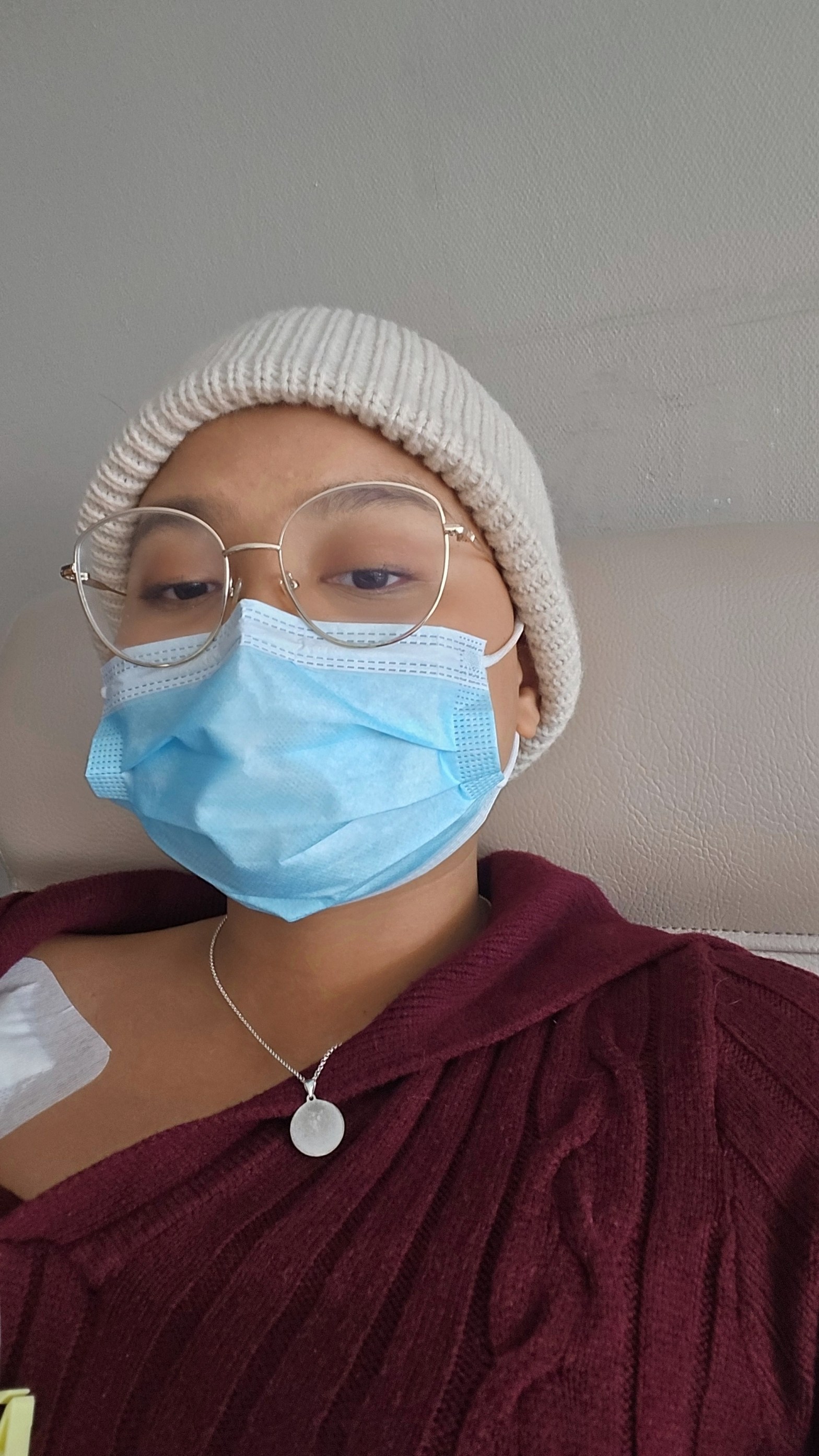
On January 21, 2025, I started Taxol.
Twelve weeks.
One session a week.
After EC, I already knew the chairs.
The blood tests.
The IVs.
The waiting.
The checks before every treatment.
I already knew how to walk into an oncology ward and hold out my arm almost automatically.
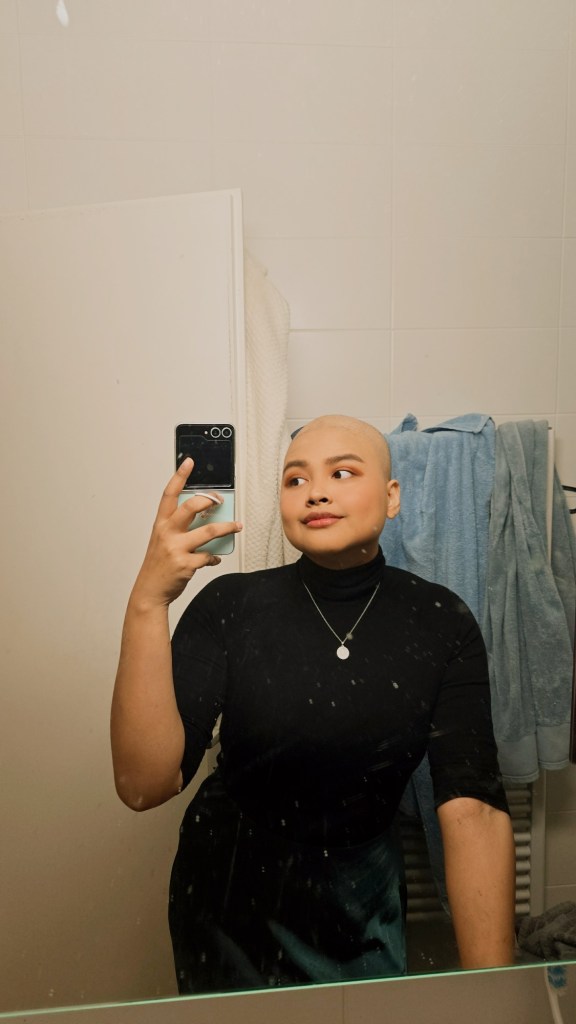
I had already lost my hair.
I had learned how to wear wigs, headscarves, scarves.
I had learned to look at my reflection differently.
Or rather, I had learned not to look at it too closely.
I thought I had already watched my body change enough.
But it kept changing.
Taxol came back every week.
One session had barely ended before the next one was already appearing on my calendar.
Twelve.
Then eleven.
Ten.
Nine.
You might think I was counting because I couldn’t wait to reach the end.
That wasn’t really it.
I counted because I needed something to count.
Because treatment had turned my life into a succession of numbers.
The doses.
The results.
The blood counts.
The appointments.
The weeks.
The sessions left.
I kept going because the protocol kept going.
I showed up because an appointment had been scheduled.
They told me where to go.
When to come.
What to take.
So I went.
It probably looked like someone fighting to stay alive.
On the inside, it was different.
—
My body had changed so quickly that I hadn’t had time to understand what was happening to me.
A few months earlier, I still had both breasts.
My hair.
A body I could criticize for ordinary things.
Then it became medical.
It had been examined.
Photographed.
Measured.
Punctured.
Cut open.
Closed again.
Reconstructed.
Operated on again.
Hooked up to IVs.
Injected.
There was always someone who needed to look at something.
Touch something.
Check something.
A scar.
A vein.
A pain.
A result.
I knew why.
I knew all of it was being done to treat me.
But knowing that didn’t fill me with the kind of gratitude people sometimes imagine someone should feel when others are trying to save them.
I hated my body.
I hated what it had become.
I hated what had to be done to it.
And some days, I almost hated everything I was doing to keep taking care of it.
—
Before cancer, I had already spent a lot of time criticizing my body.
Too fat.
Not enough of this.
Too much of that.
A stomach I didn’t like.
A number on the scale that could ruin an entire day.
Details I gave far too much importance to.
Cancer didn’t teach me to love my body.
That would make a beautiful sentence.
But it would be a lie.
It gave me new reasons to hate it.
I no longer looked only at the things I thought were imperfect.
I looked at what had been removed.
What had been reconstructed.
What had changed.
What had fallen out.
What hurt.
What no longer worked the way it used to.
I looked at a body in which something had grown without my permission and turned the rest of my life upside down.
So no, I didn’t look at it and think:
Hold on.
I didn’t ask anything of it.
—
The mastectomy had already created a distance between my body and me.
Dressed, I could sometimes forget about it.
Undressed, much less so.
All it took was a mirror.
A scar.
A different shape.
A different sensation beneath my fingers.
I knew it was me.
Of course it was me.
But knowing that a body is yours and being able to recognize it as home are two different things.
Then my hair fell out.
And cancer became impossible to hide beneath my clothes.
Even my face had changed because I no longer looked at it the same way.
I could put on a wig.
Tie a scarf around my head.
Put on makeup.
Get dressed.
Do whatever I needed to do to look a little more like the person I had been before.
Then evening came.
Everything came off.
And there I was.
Well…
what was left of me.
—
People could look at what I was going through and see courage.
I mostly saw a succession of things I had never asked for.
I hadn’t asked for cancer.
I hadn’t asked to have a breast removed.
I hadn’t asked for the recurrence.
I hadn’t asked for a second surgery.
I hadn’t asked for chemotherapy.
I hadn’t asked to lose my hair.
I hadn’t asked to learn how to wear a wig at twenty-seven.
And above all,
I had never asked my body to hold on.
It did.
That was all.
My heart kept beating.
My lungs kept breathing.
The treatments continued.
The appointments continued.
And I went along with it.
Sometimes almost mechanically.
It wasn’t courage.
It wasn’t a declaration of love for life.
It was continuing because the next step arrived before I’d even had time to decide what I truly wanted.
—
Maybe that was the hardest thing to make people understand.
I was receiving treatment meant to save me without being sure I wanted to be saved.
From the outside, my actions said:
I want to live.
I went to my appointments.
I took my medication.
I accepted the treatments.
I reported my symptoms.
But inside, I wasn’t thinking:
Save me.
Sometimes, I thought instead:
If my body gives up, at least I won’t be the one who chose it.
Chemotherapy could frighten me while, at the same time, part of me could hope it would be too much for my body to take.
That contradiction didn’t simply disappear because I kept showing up for treatment.
Quite the opposite.
It followed me all the way into the chair.
—
And then there was Jean-Louis.
He made that contradiction even more complicated.
Because he was there.
He had shaved his head before I lost my hair.
He had come with me during EC.
He had seen me throw up.
He had tried to get me to eat when I couldn’t keep anything down.
He had driven when I didn’t have the strength.
He had rearranged part of his life around something my body had caused.
And the more he took care of me, the more two completely opposite thoughts could exist inside me at the same time.
Stay for him.
And:
Set him free from you.
I didn’t want to die because he didn’t matter enough.
It was almost the opposite.
He mattered so much that I saw everything he was doing.
Everything he was enduring.
Everything my illness was forcing on him too.
So sometimes, his presence kept me here.
And sometimes, that very same presence fed my guilt.
I wanted to give him his life back.
I wanted him to stop having to watch what I ate.
To stop having to come with me.
To stop having to watch his partner be sick.
In my mind, sometimes there were only two ways for that to happen.
Get better.
Or no longer be here.
And I wasn’t sure which one would happen first.
—
I hated this body.
But it kept going.
That was almost what angered me most.
Everyone seemed to be working to keep it going.
The oncologists.
The nurses.
The surgeons.
Jean-Louis.
The medication.
And me, in the middle of this enormous effort surrounding my own survival, not even knowing whether I wanted to take part in it.
So I let it happen.
One week.
Then another.
Taxol.
Again.
Again.
Again.
And every time I looked at my reflection, I was trying less to find the Arjelynne I had been before than to understand who this person standing in front of me was.
I didn’t see a warrior.
I didn’t see a survivor.
I certainly didn’t see someone who had learned to love her body because of cancer.
I saw someone tired.
Someone angry.
Someone who no longer recognized her own body.
Someone everyone was trying to keep alive when she herself was no longer sure she knew why.
My body kept moving through treatment.
I stayed somewhere behind.
And as the weeks went by, the distance between us only seemed to grow.

 Did I survive