Illness doesn’t only reveal what a body can endure.
It reveals people, too.
There are those who show up.
Those who stay.
Those who try.
Those who don’t know what to say but say something anyway.
Those who promise they’ll be there—and actually are.
And then there are those who disappear.
Not always suddenly.
Sometimes, no one slams the door.
There is no argument.
No final conversation.
Just one less message.
Then another.
A visit that was supposed to happen, but never does.
A “see you soon” that eventually stops having a date attached to it.
And one day, you realize that someone who used to be part of your life is barely part of it anymore.
Illness does that sometimes.
It brings some people closer and pushes others away.
And it doesn’t always choose the ones you expected.
I received messages from people I never thought I would hear from.
Colleagues.
Acquaintances.
People I wasn’t necessarily particularly close to.
They could easily have gone on with their lives without writing to me.
And yet, they took a few minutes.
A few words.
I’m thinking of you.
How are you?
Stay strong.
Maybe it was only a message sent in between two things in their own day.
But on my side, sometimes it arrived on a day when my world had become very small.
So it mattered.
I discovered that people don’t all stay in the same way.
Some stay in waiting rooms.
Others around a table.
Some bring food.
Others suggest a trip.
Some write.
Some make you laugh.
Some have absolutely no idea what to do, so they simply do what they can.
And sometimes, staying means nothing more than slowing your pace so that the person who is ill can keep walking alongside everyone else.
J.L. held a different place in my life. He was my partner, and despite everything the illness had changed between us, there was still this “us” I wanted to hold on to. Cancer had already taken up so much space in our daily lives, in our plans, and in what my body allowed us—or no longer allowed us—to do that I wanted to believe there was still something waiting for us afterward. A life to find again. Plans to pick back up. Places to go. Days that would no longer be organized around illness. Some days, I wanted to live for both of us. Because he was there, because he continued to believe there was an after, and because I wanted us to be able to look back on all of this one day. When I couldn’t find a reason to keep going for myself, sometimes our relationship gave me one.
But that same presence created an almost constant sense of guilt. The more I saw everything the illness was forcing him to endure, the more I wondered what it was taking from him, too. I didn’t want to become a responsibility, or for our relationship to be reduced to one sick person and another who had to be strong enough for two. And so the thought would turn against me: I wanted to live for both of us, but I could also convince myself that he would have a better life without me. I wanted to stay to thank him for staying, and sometimes I wanted to disappear so I would no longer be a burden. It was absurd, and yet it felt completely real inside my head. Love and guilt had somehow taken root in the same place. And depending on the day, I never knew which one would weigh more heavily.
Then there were my friends.
Sabrina and Kirsty had their own way of reminding me that my life didn’t end with my treatments. They kept inviting me over for meals, suggesting outings, creating simple moments where I could talk, laugh, and become their friend again before being a sick person. Sabrina also kept planning trips whenever my health and treatment schedule allowed it. She knew perfectly well that I was ill and adapted to what I could manage, but she refused to put everything on hold until it was over. When we shared a room, I could take off my wig or my beanie, try different ones on in front of her, and sometimes even laugh about it. With them, I found something that resembled my old life. I was grateful that they continued to include me, to make plans with me, to remind me that I was still capable of experiencing something other than cancer. They didn’t pretend that nothing had changed. They simply tried to make sure that not everything did.
But even those happy moments had another side to them. Every invitation could also remind me of everything I was no longer sure I could do. I was afraid of having to cancel at the last minute, of being too tired, of not making it through an entire day, or of a trip planned around me becoming more complicated for everyone else. I was grateful that they adapted, but sometimes frustrated that they had to. I wanted to enjoy myself without calculating my energy, to walk without wondering how long my body would keep up, to accept an invitation without first having to check my treatment schedule. And beneath all of that, the guilt would return: the guilt of slowing people down, of complicating things, of indirectly asking others to change their plans for me. They never made me feel like a burden. Most of the time, I was the one who made myself feel that way. The more they tried to help me keep living normally, the more I sometimes realized just how much my normal had changed.
There were also J.L.’s friends, who, over the years, had become mine too. With them, there were card games, board games, evenings around a table, and a kind of kindness that never needed to be explained. I could take off my beanie or my wig without feeling people’s eyes change. The game continued. So did the conversations. We also went to Italy together: a day in Aosta, then Turin, sharing rooms, walking around and discovering the city, enjoying the beautiful weather and playing mini-golf. When I walked more slowly, they slowed down. No one made a big deal out of it. And I was deeply grateful for the way they acknowledged the illness without reducing me to it. With them, I could still have my place around a table, in a shared room, on a trip, within a group. The illness had changed my appearance and what I was physically capable of, but it hadn’t changed the way they welcomed me.
And yet, even then, I noticed everything. I noticed when the group slowed down because I could no longer keep up. I noticed the adjustments, even when they were made so naturally that no one pointed them out. And sometimes, it hurt. Not because of them, but because every kind gesture could become a reminder of something my body could no longer do the way it used to. I was afraid of ruining an outing, of tiring everyone else out, of becoming the person everyone had to wait for or the person everything had to be organized around. Sometimes, I wanted to tell them to keep going without me rather than watch them slow down. And at the same time, it would have hurt if they actually had. That was the contradiction of it all: wanting people to take my limitations into account without wanting those limitations to take up space; wanting them to wait for me while being unable to bear the idea of being the one everyone was waiting for. Their kindness comforted me, but it could also confront me with everything the illness had changed in me.
Then there was J.L.’s family. Over the years, they had become a little like my family too. I didn’t feel like I was simply “J.L.’s girlfriend,” invited because I happened to be part of the couple; I had my own place among them. And the illness hadn’t changed that. Birthdays, celebrations, and family gatherings continued, and I was always invited. They knew I could arrive feeling fine and be completely exhausted a few hours later, so there was always a room where I could lie down if I needed to. I could disappear for a while, sleep, and then come back to join everyone if my body allowed it. No one made me choose between being present and respecting my limits. I was grateful for that simplicity, but even more for what it represented: even while I was sick, I was still part of the family. There was a place for me around the table, but also a place for my exhaustion when I could no longer stay there.
And yet, once again, that gratitude came with something else. I noticed the adjustments. I knew a room was being kept available because I was there, that my energy could change the course of a day, and that sometimes people had to wonder whether I would be able to manage. Even though they never made me feel as though it bothered them, I sometimes felt like I was bringing the illness with me into moments that should simply have been happy. I was afraid people would worry, that they would watch me to make sure I was okay, that my exhaustion would become one more thing for them to think about. Sometimes, I wanted to stay with everyone simply so I wouldn’t be the one who had to go lie down again. And when I finally gave in and went to rest, there was that frustration of feeling my body take something away from me yet again. I was grateful that they gave me the possibility to rest without ever questioning my place among them, but I wished I didn’t need that special place to be made for me at all. It was the same contradiction again: being deeply grateful that people adapted to me while dreaming of no longer being the person everyone had to adapt to.
And then there were the healthcare professionals.
All of them.
The oncologists, surgeons, doctors, nurses, physiotherapists, but also the psychiatrists, psychologists, and every person who, at one point or another, tried to take care of some part of me. Some were treating my cancer, others the body damaged by the treatments, and others still were trying to care for what was happening inside my mind while everyone else was trying to save the rest of me. Over the months, I met so many of them that sometimes I can no longer remember all their names. But I remember the gestures. A blanket brought to me without my having to ask. A joke at exactly the right moment. An explanation repeated when I hadn’t fully understood. A question asked with enough patience to wait for the real answer. I also remember the ones in front of whom I could admit that I wasn’t okay without immediately having to pretend otherwise. In the middle of protocols, medications, tests, and appointments, I was grateful for every person who reminded me that behind the medical file, there was still a human being.
That gratitude was different from what I felt toward the people close to me. I hadn’t chosen these people, and they hadn’t chosen me either. Our paths had simply crossed because, at some point in my life, I needed them. To some of them, I entrusted my body, my scars, and my pain. To others, I entrusted thoughts I couldn’t always say anywhere else—my fears, my anger, my exhaustion, and all the contradictions living inside my head. Some were trying to repair what could still be repaired physically; others were simply helping me through what no one could see. There was something strange about that closeness with people who sometimes knew so little about my life and yet had witnessed some of its most fragile parts. Some names may eventually fade from my memory, but not the way I was cared for. Because in the middle of a time when I often felt like I no longer knew what to do with my own body or my own life, there were all these people who, each in their own way, continued to take care of both.
And despite all those people, there was loneliness.
That was probably one of the hardest things for me to understand.
I was surrounded.
Truly.
I had J.L., my friends, his family who had also become mine, the healthcare professionals, the messages, the invitations, the meals, the trips—all those people trying, each in their own way, to make that time a little less difficult.
I couldn’t say that I was alone.
And yet, I could feel terribly lonely.
For a long time, that contradiction made me feel guilty too. How could I feel so lonely when so many people were there? As though feeling lonely meant saying they weren’t doing enough. As though my sadness erased their efforts or made my gratitude less sincere. So sometimes, I kept that feeling to myself. I told myself I had no right to complain about loneliness when I was lucky enough to be surrounded by people.
But eventually, I understood that both could exist at the same time.
Being surrounded didn’t mean anyone could feel what I was feeling.
No one could inhabit my body for me.
No one could feel exactly that exhaustion, that fear, that anger, or all the thoughts that kept going once the conversations were over and everyone had gone home.
Someone could come with me to an appointment, sit beside me, walk more slowly to stay at my pace, listen to whatever I managed to put into words.
But there was always a part of the journey I had to walk alone.
And maybe that was what the loneliness of illness really looked like.
Not an empty room.
Not the absence of love.
But that invisible distance between what other people could see and everything that was actually happening inside me.
They could be there without being able to reach all the way in.
And it was no one’s fault.
The people who loved me couldn’t take my place.
The healthcare professionals couldn’t fix everything.
My friends couldn’t make my thoughts disappear simply by making me laugh.
J.L. couldn’t carry what I could no longer carry myself.
All they could do was stay.
And many of them did.
With time, I understood that this alone was immense.
There were also those who had drifted away. Some people became less present, some messages eventually stopped coming. I will probably never know exactly why. Maybe illness frightened them. Maybe some simply didn’t know what to say or how to behave in the face of something they couldn’t fix. Some absences hurt, especially when they came from people I thought would stay.
But illness also gave me the opposite.
People I had expected almost nothing from came closer. Colleagues, acquaintances, sometimes someone I thought was far removed from my life, who simply took the time to ask how I was doing.
Cancer had created a strange kind of sorting around me.
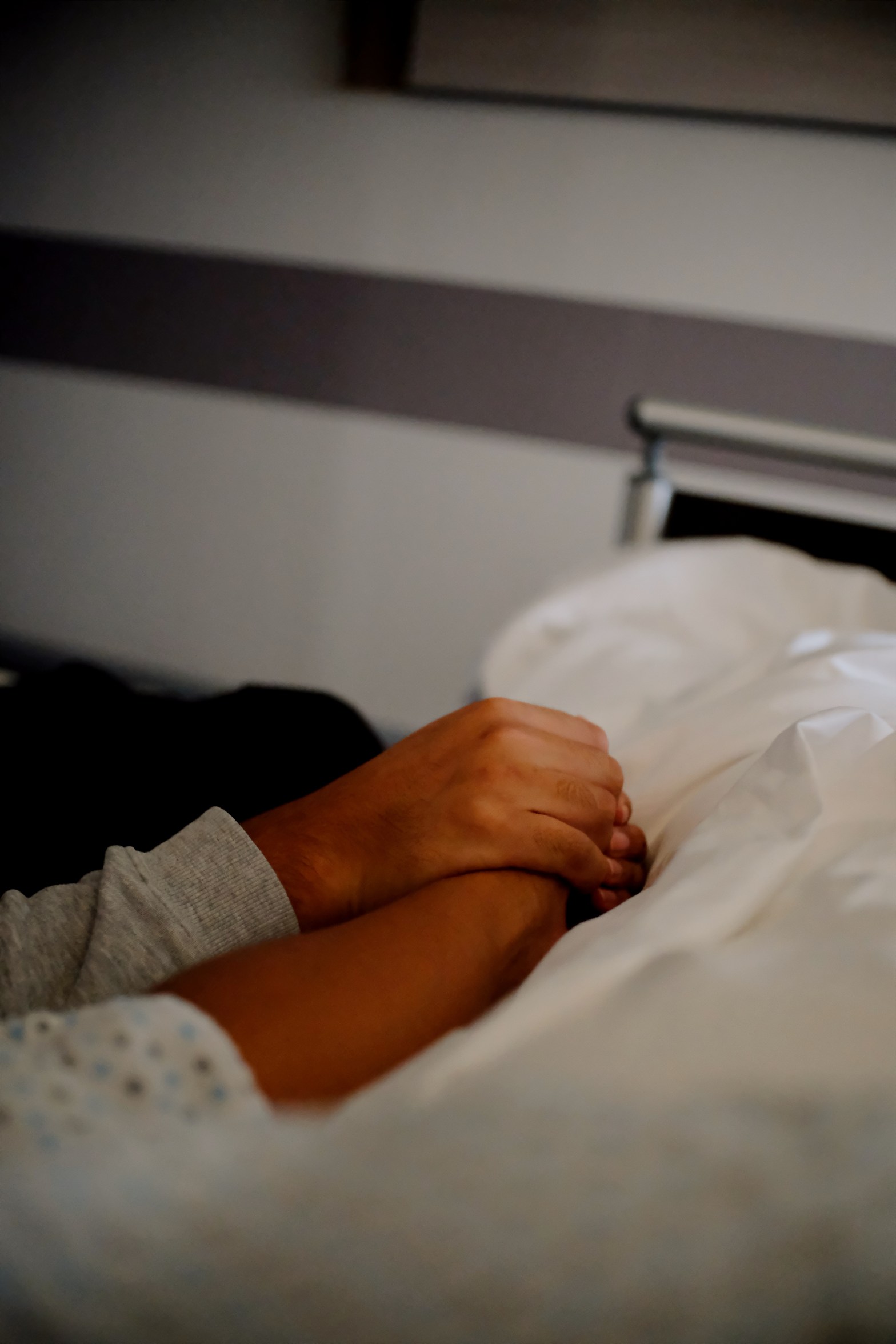
Some hands I thought were strong had let go.
Others, ones I had never imagined reaching for, had reached out to me.
And then there were the ones that had been there from the beginning.
None of them could walk the path in my place.
But they could walk beside me for as long as they were able.
So I kept going.
Not only because of them.
Not only for them.
But certainly not without them.
And while I kept going, the number of treatments kept getting smaller.
One less.
Then another.
After months of counting everything I still had left to endure, I began counting what separated me from the end.
And for the first time in a long time, that end actually felt close.
I thought I knew what it meant.
Finishing treatment.
Turning the page.
Getting my life back.
I didn’t know yet that you could reach the end of something without necessarily knowing what to do with what comes after.
Chapter 10 – the hands that stayed

 Did I survive