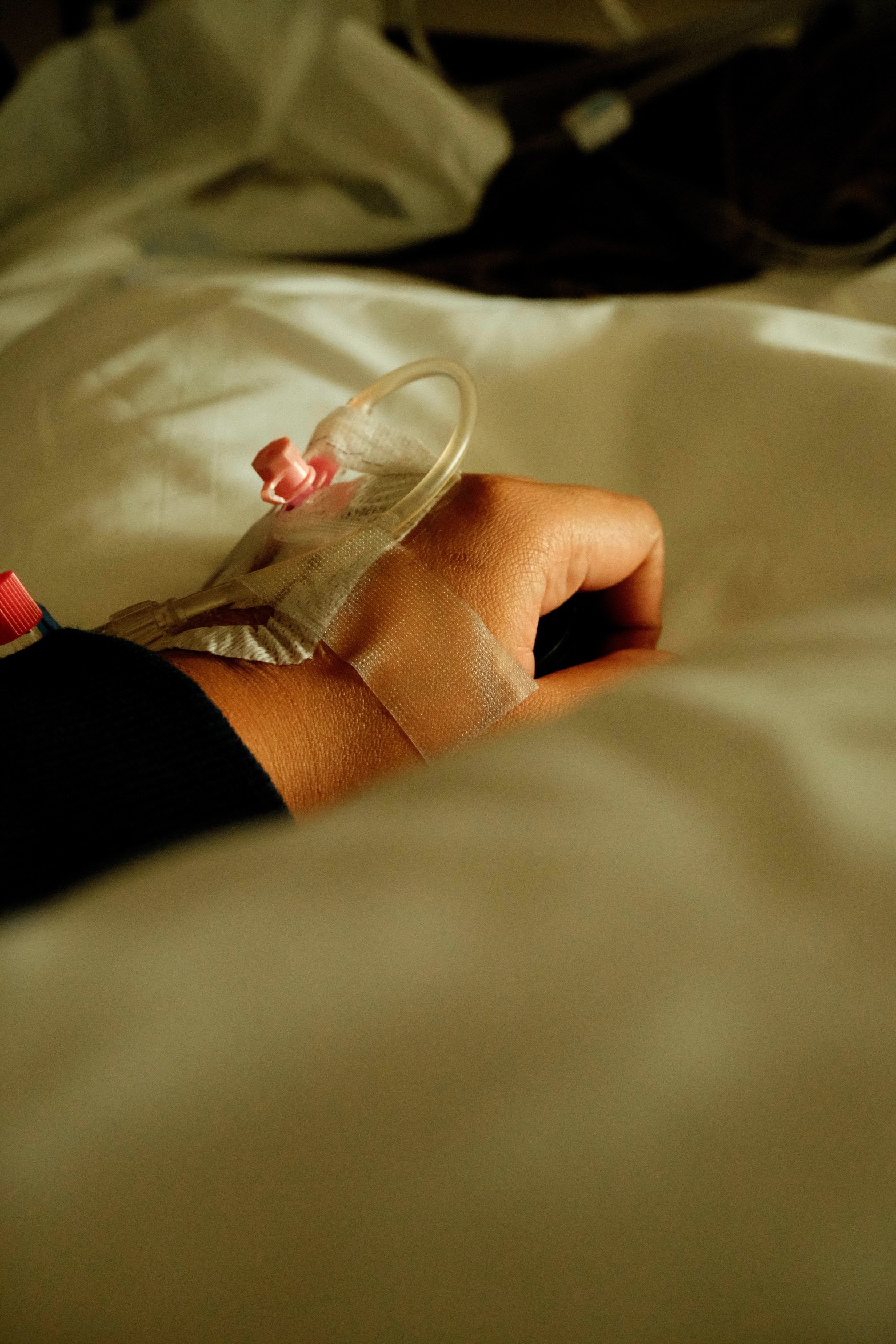
After the diagnosis, everything accelerated.
The appointments followed one another.
The examinations.
The doctors.
Words I already knew professionally had suddenly decided to become personal.
Tumor.
Surgery.
Mastectomy.
Reconstruction.
Genetics.
I heard them.
I understood them technically.
But understanding a word does not mean understanding what it is going to do to your life.
I needed surgery.
And they needed to remove my right breast.
My breast.
You might think that when someone tells you a part of your body has to be sacrificed to save you, some instinct for survival immediately takes over.
Take it. Do whatever you need to do. I want to live.
That is probably how I would have imagined myself reacting before I became ill.
But that isn’t what happened.
Because there was a problem no one could really see.
I wasn’t even sure I wanted to be saved.
Something inside me had gone dark after the diagnosis.
Or maybe something had already been fragile before, and cancer had simply finished breaking it.
I couldn’t tell you exactly when my desire to live began disappearing.
I only know that after March 12, I couldn’t find it anymore.
So when people talked about a mastectomy to save my life, there was something almost absurd about the proposition.
A breast for a life.
But what is that bargain worth when the person being promised a life doesn’t even know whether she wants it?
I wasn’t afraid of dying in the way people might have expected me to be.
I was afraid of surviving differently.
Afraid of waking up and having to learn how to live inside a body I no longer recognized.
Afraid of the mirror.
Afraid of the scar.
Afraid of what they were going to take away.
Afraid of having to continue afterward.
And somewhere inside all of that was a thought I didn’t necessarily say out loud.
A dark thought.
What if I don’t wake up?
I knew enough about medicine to know that surgery carries risks.
And instead of frightening me, part of me held on to that idea.
I hoped there would be a complication.
Not because I wanted to suffer.
Not because I wanted anything to go wrong for the people who were going to take care of me.
But because, in my mind at the time, it would have solved something I no longer knew how to solve myself.
I would leave as I was.
Before seeing my body changed.
Before the mirror.
Before having to learn how to live with what was missing.
I wouldn’t have to discover who I was afterward.
There was nothing beautiful about that thought.
It wasn’t courageous.
It wasn’t peaceful.
It was simply evidence of how far down I had fallen mentally.
I could no longer imagine far enough into the future to want what the doctors were trying to preserve.
My future.
While they were preparing everything to keep me alive, part of me was silently hoping I would never have to discover what that life looked like.
And yet, I kept going.
I went to the appointments.
I underwent the examinations.
I listened to the doctors.
I signed the papers.
I agreed to the surgery.
Perhaps that is one of the hardest contradictions to explain.
You can no longer want to live and still continue doing everything necessary to stay alive.
Sometimes the body keeps moving even after the mind has stopped knowing why.
Then came another wait.
The genetic test results.
And once again, my thoughts probably weren’t what anyone would have expected.
Part of me hoped the result would be positive.
It sounds absurd.
Who hopes to discover that they carry a genetic predisposition to cancer?
I did, at that moment.
Not because I wanted more disease.
Not because I wanted there to be something in my genes that might also affect my family.
But because, in my mind, a genetic result might give me another possibility:
Remove both breasts.
If you have to take one, then take both.
That thought strangely comforted me.
Two.
Not one.
Two.
Because at least it would be symmetrical.
At least when I looked into the mirror, I wouldn’t constantly see the difference between what had been affected and what had not.
I wouldn’t have one intact breast beside the other, reminding me every day of what my body used to look like.
In my mind, there was an almost childlike logic to it.
If you have to take one, then take both.
As though symmetry could somehow make the loss easier to bear.
As though losing more could, paradoxically, make me feel less damaged.
I didn’t want to compare.
I didn’t want to look at one side and see before, then shift my eyes slightly and see after.
If I had to have scars, let them be on both sides.
If my body had to change, then let it change completely.
If I had to learn to recognize a new chest, perhaps it would be easier without half of the old one still there to remind me constantly of what had disappeared.
I think more than anything, I was searching for control.
Since March 12, everything seemed to be slipping out of my hands.
My body.
My work.
My calendar.
My appointments.
My future.
Other people were now deciding when I needed to come in, which examinations I needed, what had to be monitored, and what needed to be removed.
So perhaps symmetry became one tiny thing I still felt I could have a say in.
I couldn’t choose whether or not I had cancer.
But maybe I could still choose what my body would look like after it.
And I discovered something strange:
You can wait for a medical result almost hoping it will be bad simply because it might open a door that, in that particular moment, feels easier to walk through.
I didn’t want more disease.
I simply wanted all of this to make some kind of sense.
And I wanted to be able to look at myself afterward.
If there was an afterward.
Because deep down, my mind had created two possibilities.
If I don’t wake up, I won’t have to see the change.
And if I do wake up, then take both.
In both scenarios, I was ultimately trying to avoid the same thing:
having to look at what cancer had done to me.
Before cancer, my breasts were simply there.
I didn’t think about them very much.
They were part of my body, like my arms, my legs, or my hair.
Some days I could like them.
Other days I could criticize them.
Think they were too much of this, not enough of that.
Look into a mirror without ever imagining that one day I would have to say goodbye to one of them.
Because we don’t think about saying goodbye to parts of our own bodies.
We assume they will stay with us.
And suddenly, my right breast had changed status.
It was no longer simply a part of me.
It was where the disease was.
The place that needed to be removed.
A part of my own body had become a threat to the rest of it.
I could place my hand over it and think two completely contradictory things.
It’s mine.
And:
Take it away.
Behind all of this came another question.
One I almost felt ashamed to ask when we were talking about cancer.
Will I still be a woman?
Rationally, I knew the answer.
Of course.
A breast does not make a woman.
I would have said that without hesitation to any patient.
I would have sincerely believed it for any other woman.
But there was an enormous difference between what I knew for others and what I could believe for myself.
I thought about clothes.
Necklines.
Intimacy.
Jean-Louis’s eyes.
And most of all, my own.
Because someone can tell you a thousand times that you are still beautiful.
At the end of the day, there comes a moment when you are alone in front of the mirror.
And no one can look for you.
We also had to talk about reconstruction.
Because medically, the conversation was no longer only about what they were going to remove.
It was already about what they were going to put in its place.
Once again, the doctors seemed several steps ahead of me.
I was still trying to accept the disappearance of part of my body while they were already asking me to think about the body I would have afterward.
What a strange thing.
Making decisions about a body you haven’t lost yet.
Looking at your own breast knowing that it now has an expiration date.
From the moment the mastectomy was decided, I think I looked at it differently.
I knew that soon, that breast would no longer exist.
Not in that form.
I knew that if I woke up after the operation, the next time I saw my chest, something would have changed forever.
On April 3, 2024, less than a month after my diagnosis, I entered the hospital for a right mastectomy with immediate reconstruction.
Only a few weeks earlier, I had been at work.
Only a few weeks earlier, I had been twenty-six.
Only a few weeks earlier, that lump had still been something I had discovered while watching television and left alone because it could have been anything.
Now I was in a hospital to have a breast removed.
The hospital wasn’t a completely unfamiliar world to me.
I was a healthcare professional.
At work, I had prepared patients who needed to be transferred to the hospital for surgery.
I knew that moment from the other side.
Preparing their belongings.
Making sure everything was in order.
Organizing the transfer.
Watching them leave for the hospital, then continuing my day caring for the other patients.
But I had never accompanied them to their operations.
I didn’t know what happened once they passed through the hospital doors.
That part of the story belonged to the patients.
And this time,
I was the patient.
There was no uniform to hide behind anymore.
No file belonging to someone else.
No transfer to organize before returning to work.
It was my name on the wristband.
My body being prepared.
My breast they were going to remove.
Jean-Louis was there.
And he was afraid.
I could feel it.
Perhaps he was more afraid of losing me than I was at that moment.
Because before going into the operating room, I knew one thing.
If I woke up, the body I had closed my eyes in would no longer exist in exactly the same way.
They were going to put me to sleep with my right breast.
Then, while I saw nothing, people would open my body, remove what needed to be removed, and try to reconstruct me.
Everything was being done so that I would wake up.
And I,
I wasn’t sure I wanted to.
I don’t need to make that thought more beautiful today.
It was there.
That’s all.
I went into the operating room carrying it with me.
Then I closed my eyes.
And despite what part of me had secretly hoped,
I woke up.
There were lights.
Voices.
Pain.
Bandages.
I was still there.
My right breast, however, was no longer there as I had known it.
There was a reconstruction.
A new shape.
A scar hidden beneath the dressings.
A body I would eventually have to look at.
Medicine had accomplished what it had set out to do.
It had brought me back from the operating room.
For the doctors, that was obviously what was supposed to happen.
For Jean-Louis, it was probably an enormous relief.
For me, things were more complicated.
Because now I had to do the thing I had been afraid of.
Continue.
At first, there were the bandages.
The care.
The pain.
The caution.
Everything could still be viewed as something medical.
A surgical wound.
A reconstruction.
A scar to monitor.
I could almost observe my body through the eyes of a healthcare professional.
Assess.
Look.
Understand.
It was easier that way.
Because looking at a scar professionally allows you, for a few seconds, to forget that it is on your own body.
But sooner or later, there is no medical vocabulary left to hide behind.
There is only a woman.
And a mirror.
I looked at myself.
I knew what I was going to see.
And yet, I didn’t know this person.
My body had changed while I was asleep.
It now carried visible proof of something no one could have seen only weeks earlier.
Before, the cancer had been hidden inside me.
Now, even after it had been removed, it had left its signature on the outside.
A scar.
A difference.
A chest that was no longer the one I had always known.
A place my eyes had recognized for twenty-seven years and suddenly had to learn all over again.
And there was still the other breast.
The one that remained.
Intact.
Familiar.
Almost cruel in its normality.
Because it showed me exactly what the other side no longer was.
It was precisely what I had feared while waiting for the genetic results.
The comparison.
Before and after on the same body.
On one side, the person I had always known.
On the other, the person cancer had changed.
People could have told me:
But you’re alive.
And it was true.
I just didn’t know yet what to do with that chance.
I hadn’t gone through surgery with that great heroic will to survive people sometimes like to talk about afterward.
I didn’t come out of the operating room thinking life was beautiful.
I simply woke up.
And now I would have to discover what that meant.
Because surgery had succeeded in removing a diseased part of my body.
But it couldn’t remove what was happening inside my mind.
It could close my skin.
It couldn’t repair my reason for living.
So I began grieving a part of my body while still having no idea what to do with the life that had just been preserved.
Not because a breast defines a woman.
But because it was mine.
Because I hadn’t chosen to lose it.
Because you can consent to an operation and still hate what it cost you.
Because you can rationally understand why a scar exists and still be unable to bear looking at it.
Because you can be surrounded by people relieved that you are alive while feeling none of that relief yourself.
I didn’t know what kind of relationship I would build with this new body.
I didn’t know whether one day I would look at that scar with pride.
With anger.
With indifference.
Or with all of those things at once.
For now, it didn’t tell a story of victory.
I wasn’t a warrior who had just won a battle.
I didn’t need to turn what had happened to me into something beautiful.
I had lost a breast.
I had a different body.
And I was still here.
That was all.
The operation had been given a very simple name:
Mastectomy.
But that word said nothing about the mirror.
Nothing about femininity.
Nothing about the symmetry I had hoped for.
Nothing about the fear of waking up different.
Nothing about the part of me that had hoped not to wake up at all.
Nothing about everything I would now have to learn to look at.
So perhaps the real bargain had never been:
A breast for a life.
Cancer had taken my breast.
Medicine had left me with my life.
And I,
I still didn’t know whether I wanted what was left of it.
Chapter 6 — A Breast for a Life